


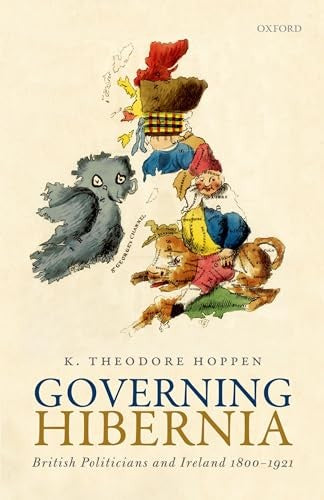
Governing Hibernia by K Theodore Hoppen
The Anglo-Irish Union of 1800 which established the United Kingdom of Great Britain and Ireland made British ministers in London more directly responsible for Irish affairs than had previously been the case. The Act did not, however, provide for full integration, and left in existence a separate administration in Dublin under a Viceroy and a Chief Secretary. This created tensions that were never resolved. The relationship that ensued has generally been interpreted in terms of 'colonialism' or 'post-colonialism', concepts not without their problems in relation to a country so geographically close to Britain and, indeed, so closely connected constitutionally. Governing Hibernia seeks to examine the Union relationship from a new and different perspective. In particular it argues that London's policies towards Ireland in the period between the Union and the Anglo-Irish Treaty of 1921 oscillated sharply. At times, the policies were based on a view of an Ireland so distant, different, and violent that (regardless of promises made in 1800) its government demanded peculiarly Hibernian policies of a coercive kind (c. 1800-1830); at others, they were based on the premise that stability was best achieved by a broadly assimilationist approach -- in effect attempting to make Ireland more like Britain (c. 1830-1868); and finally they made a return to policies of differentiation though in less coercive ways than had been the case in the decades immediately after the Union (c. 1868-1921). The outcome of this last policy of differentiation was a disposition, ultimately common to both of the main British political parties, to grant greater measures of devolution and ultimately independence, a development finally rendered viable by the implementation of Irish partition in 1921/2.
given our tendency to view the period as a struggle for independence, this fascinating book on the failure of the Union offers a useful change of perspective* Dr Christopher Kissane, Irish Times *
This is a scintillating work of interpretation based on a lifetime of deep study of British and Irish politics and is likely to provoke lively and prolonged historical debate among historians of Britain and Ireland alike. * Peter Gray, Irish Historical Studies *
The research that backs this serpentine narrative is deeply impressive: more than one hundred archives and sets of papers were consulted, while the range of secondary sources is exemplary and reassuring. Learning is carried lightly and displayed always for the benefit of the reader. Complicated tales are told and made easy to follow, and a huge cast of characters is allowed to strut and stumble ... this is first-class scholarship, expertly communicated and full of interest. * Seán McConville, American Historical Review *
Governing Hibernia offers a compelling framework for understanding the Anglo-Irish relationship during the Union from the perspective of the British ruling class. Hoppen's mastery of the sources testifies to a professional life devoted to scrupulous archival research, and his command of the material is evident in his sparkling, often irreverent prose, which makes this study that rara avis, a work of serious scholarship that is also a pleasure to read ... Grandly conceived, closely argued, and carefully executed, this book will oblige Irish historians to engage with it for decades to come. * Douglas Kanter, Journal of British History *
[The book] offers a magisterial survey of the attitudes and intentions that formed the ways in which successive British governments attempted to govern Ireland between the 1801 Act of Union and that Act's 'effective demise' in 1921. [It] is a tour de force of historical reconstruction over a century and more of Anglo- Irish relations. * Thomas Bartlett, History *
This is a scintillating work of interpretation based on a lifetime of deep study of British and Irish politics and is likely to provoke lively and prolonged historical debate among historians of Britain and Ireland alike. * Peter Gray, Irish Historical Studies *
The research that backs this serpentine narrative is deeply impressive: more than one hundred archives and sets of papers were consulted, while the range of secondary sources is exemplary and reassuring. Learning is carried lightly and displayed always for the benefit of the reader. Complicated tales are told and made easy to follow, and a huge cast of characters is allowed to strut and stumble ... this is first-class scholarship, expertly communicated and full of interest. * Seán McConville, American Historical Review *
Governing Hibernia offers a compelling framework for understanding the Anglo-Irish relationship during the Union from the perspective of the British ruling class. Hoppen's mastery of the sources testifies to a professional life devoted to scrupulous archival research, and his command of the material is evident in his sparkling, often irreverent prose, which makes this study that rara avis, a work of serious scholarship that is also a pleasure to read ... Grandly conceived, closely argued, and carefully executed, this book will oblige Irish historians to engage with it for decades to come. * Douglas Kanter, Journal of British History *
[The book] offers a magisterial survey of the attitudes and intentions that formed the ways in which successive British governments attempted to govern Ireland between the 1801 Act of Union and that Act's 'effective demise' in 1921. [It] is a tour de force of historical reconstruction over a century and more of Anglo- Irish relations. * Thomas Bartlett, History *
K. Theodore Hoppen was born in Germany and moved to Ireland in 1947. He was educated at Glenstal Abbey School, University College Dublin, and Trinity College Cambridge. He worked in the History Department at the University of Hull from 1966 to 2003, and was made a Fellow of the British Academy in 2001 and an Honorary Member of the Royal Irish Academy in 2010.
| SKU | Unavailable |
| ISBN 13 | 9780198207436 |
| ISBN 10 | 0198207433 |
| Title | Governing Hibernia |
| Author | K Theodore Hoppen |
| Condition | Unavailable |
| Binding Type | Hardback |
| Publisher | Oxford University Press |
| Year published | 2016-08-18 |
| Number of pages | 352 |
| Prizes | Winner of Winner of the 2017 Irish Historical Research Prize. |
| Cover note | Book picture is for illustrative purposes only, actual binding, cover or edition may vary. |
| Note | Unavailable |