
Handbook of Combinatorial Optimization


Handbook of Combinatorial Optimization
Regular price
Checking stock...
Regular price
Checking stock...
Summary
Furthermore, combinatorial optimization problems occur in many diverse areas such as linear and integer programming, graph theory, artificial intelligence, and number theory. Many polynomial-time solvable combinatorial optimization problems are special cases of linear programming (e.g.
The feel-good place to buy books
- Free US shipping over $15
- Buying preloved emits 41% less CO2 than new
- Millions of affordable books
- Give your books a new home - sell them back to us!
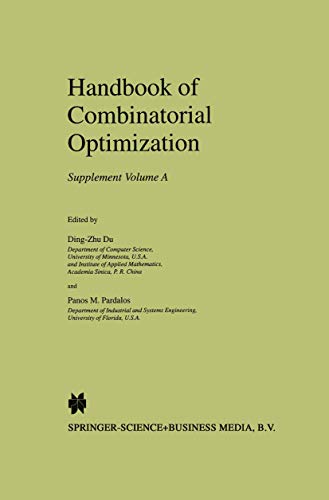
Handbook of Combinatorial Optimization by Ding-Zhu Du
Combinatorial (or discrete) optimization is one of the most active fields in the interface of operations research, computer science, and applied math- ematics. Combinatorial optimization problems arise in various applications, including communications network design, VLSI design, machine vision, air- line crew scheduling, corporate planning, computer-aided design and man- ufacturing, database query design, cellular telephone frequency assignment, constraint directed reasoning, and computational biology. Furthermore, combinatorial optimization problems occur in many diverse areas such as linear and integer programming, graph theory, artificial intelligence, and number theory. All these problems, when formulated mathematically as the minimization or maximization of a certain function defined on some domain, have a commonality of discreteness. Historically, combinatorial optimization starts with linear programming. Linear programming has an entire range of important applications including production planning and distribution, personnel assignment, finance, alloca- tion of economic resources, circuit simulation, and control systems. Leonid Kantorovich and Tjalling Koopmans received the Nobel Prize (1975) for their work on the optimal allocation of resources. Two important discover- ies, the ellipsoid method (1979) and interior point approaches (1984) both provide polynomial time algorithms for linear programming. These algo- rithms have had a profound effect in combinatorial optimization. Many polynomial-time solvable combinatorial optimization problems are special cases of linear programming (e.g. matching and maximum flow). In addi- tion, linear programming relaxations are often the basis for many approxi- mation algorithms for solving NP-hard problems (e.g. dual heuristics).DING-ZHU DU, PhD, is Professor of Computer Science at the University of Minnesota.
KER-I KO, PhD, is Professor of Computer Science at the State University of New York at Stony Brook. The two are also coauthors of Theory of Computational Complexity (Wiley).
| SKU | Unavailable |
| ISBN 13 | 9780792359241 |
| ISBN 10 | 0792359240 |
| Title | Handbook of Combinatorial Optimization |
| Author | Ding-Zhu Du |
| Condition | Unavailable |
| Binding Type | Hardback |
| Publisher | Kluwer Academic Publishers |
| Year published | 1999-10-31 |
| Number of pages | 648 |
| Cover note | Book picture is for illustrative purposes only, actual binding, cover or edition may vary. |
| Note | Unavailable |