


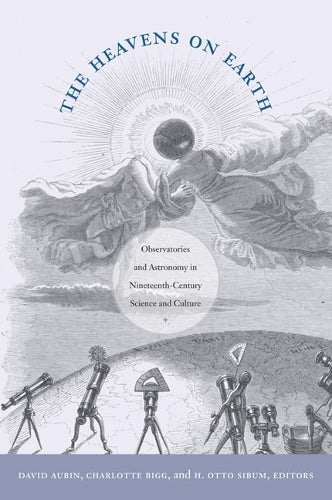
The Heavens on Earth by David Aubin
A collection exploring the place of the observatory in nineteenth-century science, culture.
“It is hard to do justice to this excellent book in a short review. . . The essays as a whole constitute an extremely valuable resource for astronomical historians. . . . The Heavens on Earth is a meticulously-documented scholarly work. . . .” - Allan Chapman, The Observatory Magazine “The contributors to this book are to be congratulated for putting together a thought-provoking and wide-ranging collection of essays. The editors should be thanked not only for bringing these together but for providing a thorough review of the field in their introduction and the excellent bibliography.” - Rebekah Higgitt, British Journal for the History of Science “I recommend this book to those interested in the late enlightenment and Victorian period that heralded advances in science and the philosophical stance of astronomy.”
specialized readers new insights into the social and cultural history of nineteenth-century astronomy.” - Pedro Ruis-Castell, Journal for the History of Astronomy “The Heavens on Earth represents the most comprehensive work yet produced on the political, military and cultural significance of nineteenth-century astronomical observatories. It is highly recommended for all scholars
interested in the instruments and techniques by which those observatories
became the very model of scientific precision.” - Steven Ruskin, Technology and Culture “In crafting this collection, this well-tuned team of editors never hits a sour note. . . . The masterful introduction provides a cogent mapping of the collection’s contents. . . . [T]his volume provides an extraordinarily useful reframing of a significant aspect of nineteenth-century astronomy. These essays refocus our attention from the facades of those monolithic monuments on the ill to the living, breathing observers within their walls who indefatigably struggled to see, measure, record, and share their vision of heavenly and earthly phenomena.” - Pamela Gossin, Victorian Studies “The Heavens on Earth raises the bar for the historiography of astronomy and observatory techniques. The collection stands out from the existing literature in its attention to the broad cultural context of observatory work and techniques; continental Europe in addition to Great Britain and the United States; the connections between the observatory and ‘popular’ astronomy; and the links between astronomy and concerns such as geodesy, the rating of chronometers, and military science. It is a major contribution to the history of not only astronomy but also nineteenth-century science and its culture.”-Robert W. Smith, University of Alberta, co-author of Hubble: Imaging Space and Time “This impressive volume is the first to offer a panoramic view of the observatory as site of science, empire, and modernization during its golden age. At the forefront of precision measurement, standardization, number-crunching, and worldwide networking, the nineteenth-century observatory made globalization a reality.”-Lorraine Daston, Max Planck Institute for the History of Science, Berlin “The Heavens on Earth represents the most comprehensive work yet produced on the political, military and cultural significance of nineteenth-century astronomical observatories. It is highly recommended for all scholars interested in the instruments and techniques by which those observatories became the very model of scientific precision.” - Steven Ruskin (Technology and Culture) “I recommend this book to those interested in the late enlightenment and Victorian period that heralded advances in science and the philosophical stance of astronomy.”
- Ian Welland, Astronomy Now
specialized readers new insights into the social and cultural history of nineteenth-century astronomy.” - Pedro Ruis-Castell, Journal for the History of Astronomy “The Heavens on Earth represents the most comprehensive work yet produced on the political, military and cultural significance of nineteenth-century astronomical observatories. It is highly recommended for all scholars
interested in the instruments and techniques by which those observatories
became the very model of scientific precision.” - Steven Ruskin, Technology and Culture “In crafting this collection, this well-tuned team of editors never hits a sour note. . . . The masterful introduction provides a cogent mapping of the collection’s contents. . . . [T]his volume provides an extraordinarily useful reframing of a significant aspect of nineteenth-century astronomy. These essays refocus our attention from the facades of those monolithic monuments on the ill to the living, breathing observers within their walls who indefatigably struggled to see, measure, record, and share their vision of heavenly and earthly phenomena.” - Pamela Gossin, Victorian Studies “The Heavens on Earth raises the bar for the historiography of astronomy and observatory techniques. The collection stands out from the existing literature in its attention to the broad cultural context of observatory work and techniques; continental Europe in addition to Great Britain and the United States; the connections between the observatory and ‘popular’ astronomy; and the links between astronomy and concerns such as geodesy, the rating of chronometers, and military science. It is a major contribution to the history of not only astronomy but also nineteenth-century science and its culture.”-Robert W. Smith, University of Alberta, co-author of Hubble: Imaging Space and Time “This impressive volume is the first to offer a panoramic view of the observatory as site of science, empire, and modernization during its golden age. At the forefront of precision measurement, standardization, number-crunching, and worldwide networking, the nineteenth-century observatory made globalization a reality.”-Lorraine Daston, Max Planck Institute for the History of Science, Berlin “The Heavens on Earth represents the most comprehensive work yet produced on the political, military and cultural significance of nineteenth-century astronomical observatories. It is highly recommended for all scholars interested in the instruments and techniques by which those observatories became the very model of scientific precision.” - Steven Ruskin (Technology and Culture) “I recommend this book to those interested in the late enlightenment and Victorian period that heralded advances in science and the philosophical stance of astronomy.”
David Aubin is Professor of History of Science at the UniversitÉ Pierre et Marie Curie, Paris, and a member of the Institut de MathÉmatiques de Jussieu.
Charlotte Bigg is a research scientist at the Centre National de la Recherche Scientifique (Centre Alexandre KoyrÉ, Paris).
H. Otto Sibum is Hans Rausing Professor of History of Science and Director of the Office for History of Science at Uppsala University in Sweden.
| SKU | Unavailable |
| ISBN 13 | 9780822346401 |
| ISBN 10 | 0822346400 |
| Title | The Heavens on Earth |
| Author | David Aubin |
| Series | Science And Cultural Theory |
| Condition | Unavailable |
| Binding Type | Paperback |
| Publisher | Duke University Press |
| Year published | 2010-01-26 |
| Number of pages | 400 |
| Cover note | Book picture is for illustrative purposes only, actual binding, cover or edition may vary. |
| Note | Unavailable |