


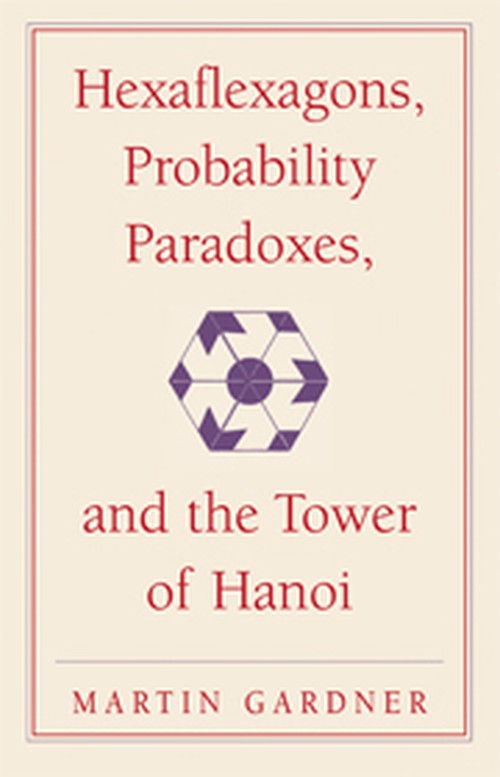
Hexaflexagons, Probability Paradoxes, and the Tower of Hanoi by Martin Gardner
Paradoxes and paper-folding, Moebius variations and mnemonics, fallacies, magic squares, topological curiosities, parlor tricks, and games ancient and modern, from Polyominoes, Nim, Hex, and the Tower of Hanoi to four-dimensional ticktacktoe. These mathematical recreations, clearly and cleverly presented by Martin Gardner, delight and perplex while demonstrating principles of logic, probability, geometry, and other fields of mathematics. Hexaflexagons, Probability Paradoxes, and the Tower of Hanoi is the inaugural volume in Martin Gardner's New Mathematical Library. This book of the earliest of Gardner's enormously popular Scientific American columns and puzzles continues to challenge and fascinate readers. Now the author, in consultation with experts, has added updates to all the chapters, including new game variations, mathematical proofs, and other developments and discoveries.
'Gardner's monthly romp through recreational math and logic ran in Scientific American for 25 years, from the Sputnik splash to the Reagan reign, and nobody has been able to match it since'Mathematical Games' was an orgy of right-brain tomfoolery that could be approached for superficial fun or deep insight, or both at the same time … I can't think of a better present for a clever 12-year old, bored undergraduate, restless retiree, or stay-at-home parent fearing intellectual stagnation.' David Brooks, The Telegraph
'Hexaflexagons, Probability Paradoxes, and the Tower of Hanoi and Origami, Eleusis, and the Soma Cube provide a taste of Gardner's prowess at devising quirky and fascinating mathematical conundrums. An excellent example is the 'generalised ham-sandwich theorem', which, among other things, explains how a doughnut can be sliced into 13 pieces by three simultaneous plane cuts.' Physics World
'For libraries, these famous and important books are an essential acquisition: they can have a complete set, with a uniform look, including updates. It is hard to exaggerate the importance and influence of these books. … what makes it all work is Gardner's writing. He is simple and direct, his explanations are clear, and he always includes the reader, inviting us to build models, play games, try out methods, solve problems. The readers respond, participate, and contribute, often in creative and productive ways. … These books are fascinating, useful, fun, and historically significant. You must have them! Buy one for yourself, and buy many to give away. Have your students read them. Give a set to your local high school (they'll be published over five years, so it won't even be a financial burden). Time has passed, and a generation that knoweth not Gardner has arisen. Now we can fix that.' MAA Reviews
'I believe that many readers will enjoy the book with great pleasure.' EMS Newsletter
'Hexaflexagons, Probability Paradoxes, and the Tower of Hanoi and Origami, Eleusis, and the Soma Cube provide a taste of Gardner's prowess at devising quirky and fascinating mathematical conundrums. An excellent example is the 'generalised ham-sandwich theorem', which, among other things, explains how a doughnut can be sliced into 13 pieces by three simultaneous plane cuts.' Physics World
'For libraries, these famous and important books are an essential acquisition: they can have a complete set, with a uniform look, including updates. It is hard to exaggerate the importance and influence of these books. … what makes it all work is Gardner's writing. He is simple and direct, his explanations are clear, and he always includes the reader, inviting us to build models, play games, try out methods, solve problems. The readers respond, participate, and contribute, often in creative and productive ways. … These books are fascinating, useful, fun, and historically significant. You must have them! Buy one for yourself, and buy many to give away. Have your students read them. Give a set to your local high school (they'll be published over five years, so it won't even be a financial burden). Time has passed, and a generation that knoweth not Gardner has arisen. Now we can fix that.' MAA Reviews
'I believe that many readers will enjoy the book with great pleasure.' EMS Newsletter
For 25 of his 90 years, Martin Gardner wrote 'Mathematical Games and Recreations', a monthly column for Scientific American magazine. These columns have inspired hundreds of thousands of readers to delve more deeply into the large world of mathematics. He has also made significant contributions to magic, philosophy, debunking pseudoscience, and children's literature. He has produced more than 60 books, including many best sellers, most of which are still in print. His Annotated Alice has sold more than a million copies. He continues to write a regular column for the Skeptical Inquirer magazine.
| SKU | Unavailable |
| ISBN 13 | 9780521735254 |
| ISBN 10 | 0521735254 |
| Title | Hexaflexagons, Probability Paradoxes, and the Tower of Hanoi |
| Author | Martin Gardner |
| Series | The New Martin Gardner Mathematical Library |
| Condition | Unavailable |
| Binding Type | Paperback |
| Publisher | Cambridge University Press |
| Year published | 2008-09-08 |
| Number of pages | 208 |
| Cover note | Book picture is for illustrative purposes only, actual binding, cover or edition may vary. |
| Note | Unavailable |