


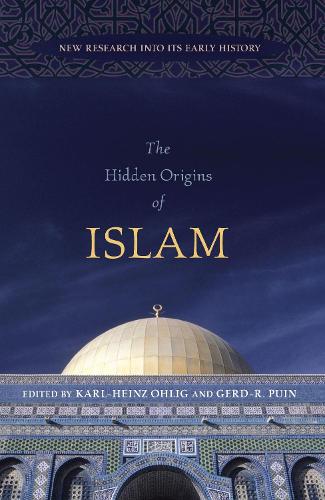
The Hidden Origins of Islam by Karl-Heinz Ohlig
Despite Muhammad's exalted place in Islam, even today there is still surpisingly little actually known about this shadowy figure and the origins of the Qur'an because of an astounding lack of verifiable biographical material. Furthermore, most of the existing biographical traditions that can be used to substantiate the life of Muhammad date to nearly two centuries after his death, a time when a powerful, expansive, and idealized empire had become synonymous with his name and vision - thus resulting in an exaggerated and often artificial characterization of the prophetic figure coupled with many questionable interpretations of the holy book of Islam. On the basis of datable and localizable artifacts from the seventh and eighth centuries of the Christian era, many of the historical developments, misconceptions, and fallacies of Islam can now be seen in a different light. Excavated coins that predate Islam and the old inscription in the Dome of the Rock in Jerusalem utilize symbols used in a documented Syrian Arabic theology - a theology with Christian roots. Interpreting traditional contexts of historical evidence and rereading passages of the Qur'an, the researchers in this thought-provoking volume unveil a surprising - and highly unconventional - picture of the very foundations of Islamic religious history.
"The scholarly basis of this important proposal [a new cultural interpretation of the rapid expansion of Islam in the 7th and 8th centuries CE] resides on the one hand on the observation that there is a striking lack of original written material which attests to the doctrine that we know today as Islam, from this early pre-Abbasid periodOn the other it is underpinned by detailed study of the textual material which does derive from this era, as well as careful interpretation of the many written sources which became available after the beginning of the Abbasid ascendancy. However, if Islam during this era did not resemble what we know it as today, what was it? On this point the authors break unity, some giving bold, alternative interpretations, others working at the question from detailed, nuanced angles. What the current volume succeeds in doing is to refocus attention on [longstanding beliefs regarding the origins of Islam], and to situate the scholarly problem in very legitimate religious, political, cultural, and linguistic questions, within the context both of new scholarly interpretations and findings, and state of the art overviews of long-discussed issues...the prospect of bringing the two perspectives [traditional and new] together holds the promise of a lively, interesting and new chapter in western Islamic studies." --Arabica, Vol. 55, 2008
Karl-Heinz Ohlig is professor emeritus of Religious Studies and the History of Christianity at the University of the Saarland, chairman of the Inarah Institute for Research into the Early History of Islam and the Qur'an, and the author of many books including Weltreligion Islam: Eine Einf�hrung (Islam as World Religion: An Introduction). Gerd-R. Puin, a retired research associate at the University of the Saarland, is an expert on the historical orthography of the Qur'an.
| SKU | Unavailable |
| ISBN 13 | 9781591026341 |
| ISBN 10 | 1591026342 |
| Title | The Hidden Origins of Islam |
| Author | Karl-Heinz Ohlig |
| Condition | Unavailable |
| Binding Type | Hardback |
| Publisher | Prometheus Books |
| Year published | 2009-07-30 |
| Number of pages | 406 |
| Cover note | Book picture is for illustrative purposes only, actual binding, cover or edition may vary. |
| Note | Unavailable |