


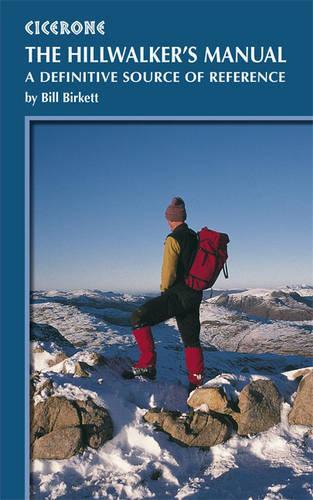
The Hillwalker's Manual by Bill Birkett
The leading practical manual for the hillwalker, covering equipment, safety, navigation, survival and photography. The book is split into the following sections: The Hillwalker's World - weather and seasons, physical features, altitude and nature, organisations, hill environment; Equipment - footwear, clothing, rucksacks, winter, equipment care; Navigation - using the map, compass work, other methods of navigation; Techniques - Route planning, preparation, footcare, group leadership, solo walking, walking technique; Survival - being prepared, dealing with natural hazards, accident and rescue; and Photography - cameras, lenses, filters, tripods, film, storage, techniques, sharp photographs, light, composition.
'This is a beautifully produced book illustrated by good diagrams and quite stunning photographsWith a title like this I would expect to find the essential topics covered in detail and Bill Birkett does exactly this with the chapters on Equipment, Navigation, Techniques and Survival. An unexpected chapter on photography makes for a welcome addition to a book on hillwalking - I say unexpected simply because authors do not usually cover it, but most of us carry a camera from time to time and there are few better qualified to pass on some tips than Bill Birkett. The chapter on Survival deals as much with avoiding the issue as it does with what to do when in it, but I didn't find any reference to a survival bag, which protects you from the wind and so is a real lifesaver. I am not talking about the so-called orange plastic survival bags which are good for sledging and useless for survival, but about lightweight nylon bags which come in various sizes - or they can be easily made. I can't recall when last on the hill in summer or winter without one. And the Weather section is a bit lightweight. I am left wondering how he can justify 30 pages on photography (good as they are) while skipping over this pretty important issue in only 6? Maybe I would have felt better if he had suggested a weather book or two, but this is not so - in fact, there is no bibliography, which I think, is an unfortunate omission. One point with which I definitely disagree is the advice that at least 24 hours should be allowed after snowfall before one ventures onto the hill, and a period of three days or more is preferable. This out-of-date view has its history in the Alps, and even then it was wrong. With understanding of snow craft it is perfectly possible to go out in the hills both during and immediately after snowfall without incurring undue risk - witness the hundreds (no, thousands) of people who regularly do so in this country and elsewhere. And on the subject of snow, if you go out to practice self-arrest with the ice axe I advise the wearing of a helmet and no crampons (unlike the book's illustrations), advice based on the bitter experience over many years of teaching this skill.But despite these niggles this book is packed with excellent information and it is brilliantly illustrated.' (Peter Cliff, The British Army Review Number 133)
Bill Birkett is an experienced walker and climber and has written extensively on many outdoor activities, especially Lakeland climbing and walking.
| SKU | Unavailable |
| ISBN 13 | 9781852843410 |
| ISBN 10 | 1852843411 |
| Title | The Hillwalker's Manual |
| Author | Bill Birkett |
| Condition | Unavailable |
| Binding Type | Paperback |
| Publisher | Cicerone Press |
| Year published | 2009-03-13 |
| Number of pages | 160 |
| Cover note | Book picture is for illustrative purposes only, actual binding, cover or edition may vary. |
| Note | Unavailable |