


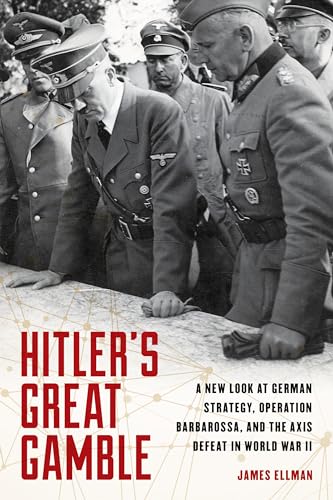
Hitler's Great Gamble by James Ellman
On June 22, 1941, Hitler invaded the Soviet Union in Operation Barbarossa, one of the turning points of World War I. Within six months, the invasion bogged down on the outskirts of Moscow, and the Eastern Front proved to be the decisive theater in the defeat of the Third Reich. Ever since, most historians have agreed that this was Hitler's gravest mistake. In Hitler's Great Gamble, James Ellman argues that while Barbarossa was a gamble and perverted by genocidal Nazi ideology, it was not doomed from the start. Rather it represented Hitler's best chance to achieve his war aims for Germany which were remarkably similar to those of the Kaiser's government in 1914. Other options, such as an invasion of England, or an offensive to seize the oil fields of the Middle East were considered and discarded as unlikely to lead to Axis victory. In Ellman's recounting, Barbarossa did not fail because of flaws in the Axis invasion strategy, the size of the USR, or the brutal cold of the Russian winter. Instead, German defeat was due to errors of Nazi diplomacy. Hitler chose not to coordinate his plans with his most militarily powerful allies, Finland and Japan, and ensure the seizure of the ports of Murmansk and Vladivostok. Had he done so, Germany might well have succeeded in defeating the Soviet Union and, perhaps, winning World War I. Drawing on a wealth of primary and secondary sources (including many recently released), Hitler's Great Gamble is a provocative work that will appeal to a wide cross-section of World War I buffs, enthusiasts, and historians.
This startlingly original account places one of the key episodes of World War II in an entirely new lightDeeply researched and briskly written, it contradicts the standard view that Hitler's invasion of the Soviet Union was an act of military madness. Ellman's work reshapes our understanding of history--and shows how much remains to be learned about the 20th century's great cataclysm. -- Stephen Kinzer, author of The True Flag and Poisoner in Chief
The author challenges conventional wisdom with a bold, fresh interpretation of one of the watershed events of the twentieth century: Operation Barbarossa, Adolf Hitler’s attack on the Soviet Union in June 1941. In a sweeping overview of events--based in part on official archival sources and recollections of key participants, Ellman argues that, far from being a catastrophic mistake, Hitler’s decision to attack Russia was a `logical gamble . . . that came extremely close to success.’ The fast-paced narrative will give laypersons and historians alike much to contemplate. -- Craig Luther, author of The First Day on the Eastern Front
The author challenges conventional wisdom with a bold, fresh interpretation of one of the watershed events of the twentieth century: Operation Barbarossa, Adolf Hitler’s attack on the Soviet Union in June 1941. In a sweeping overview of events--based in part on official archival sources and recollections of key participants, Ellman argues that, far from being a catastrophic mistake, Hitler’s decision to attack Russia was a `logical gamble . . . that came extremely close to success.’ The fast-paced narrative will give laypersons and historians alike much to contemplate. -- Craig Luther, author of The First Day on the Eastern Front
James Ellman, the grandson of Holocaust survivors, holds a bachelor’s degree in history and economics from Tufts University and an MBA from Harvard. He lives near San Francisco, California.
| SKU | Unavailable |
| ISBN 13 | 9780811738491 |
| ISBN 10 | 0811738493 |
| Title | Hitler's Great Gamble |
| Author | James Ellman |
| Condition | Unavailable |
| Binding Type | Hardback |
| Publisher | Stackpole Books |
| Year published | 2019-09-20 |
| Number of pages | 272 |
| Cover note | Book picture is for illustrative purposes only, actual binding, cover or edition may vary. |
| Note | Unavailable |