


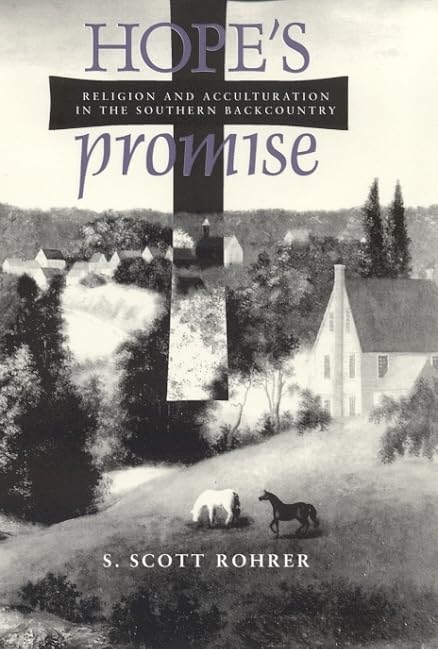
Hope's Promise by S Scott Rohrer
This eloquent study describes the complex process of assimilation that occurred among multi-ethnic groups in Wachovia, the evangelical community that settled a 100,000-acre tract in Piedmont North Carolina from 1750 to 1860. It counters commonplace notions that evangelicalism was a divisive force in the antebellum South, demonstrating instead the ability of evangelical beliefs and practices to unify diverse peoples and foster shared cultural values. In Hope's Promise, Scott Rohrer dissects the internal workings of the ecumenical Moravian movement at Wachovia - how this disparate group of pilgrims hailing from many countries (Germany, Ireland, Scandinavia, England) and different denominations (Lutheran, Reformed, Methodist, Anglican) yielded their ethnicities as they became, above all, a people of faith. By examining the ""open"" farm congregations of Hope, Friedberg, and Friedland, Rohrer offers a sensitive portrayal of their evangelical life and the momentous cultural changes it wrought: the organization of tight-knit congregations bound by ""heart religion;"" the theology of the new birth; the shape of religious discipline; the sacrament of communion; and the role of music. Drawing on courthouse documents and church records, Rohrer carefully demonstrates how various groups began to take on traits of the others. He also illustrates how evangelical values propelled interaction with the outside world - at the meetinghouse and the frontier store, for example - and fostered even more collective and accelerated change. As the Moravians became ever more ""American"" and ""southern,"" the polyglot of ethnicities that was Wachovia would, under the unifying banner of evangelicalism, meld into one of the most sophisticated religious communities in early America.
A fine piece of scholarship - deeply researched and beautifully written- Randy Sparks, author of On Jordan's Stormy Banks: Evangelicalism in Mississippi; A careful, perceptive, imaginative account of religious acculturation.... The Moravians did not really 'decline' from some Old World set of beliefs but rather absorbed new ideas, triangulated themselves between piety, the world, and ethnic attitudes, and - with their core religious beliefs as a sort of gyroscope - journeyed along across a century of time to become a different people by 1850, but still recognizably distinct and set apart by their religious beliefs. - John B. Boles, author of The Great Revival: Beginnings of the Bible Belt
S. Scott Rohrer is an independent scholar and Senior Copy Editor for National Journal in Washington, D.C.
| SKU | Unavailable |
| ISBN 13 | 9780817314354 |
| ISBN 10 | 0817314350 |
| Title | Hope's Promise |
| Author | S Scott Rohrer |
| Series | Religion And American Culture |
| Condition | Unavailable |
| Publisher | The University of Alabama Press |
| Year published | 2005-01-31 |
| Number of pages | 304 |
| Cover note | Book picture is for illustrative purposes only, actual binding, cover or edition may vary. |
| Note | Unavailable |