
How Can the Human Mind Occur in the Physical Universe?


How Can the Human Mind Occur in the Physical Universe?
Regular price
Checking stock...
Regular price
Checking stock...
Summary
The human cognitive architecture consists of a set of largely independent modules associated with different brain regions. This book discusses in detail how these various modules can combine to produce behaviours as varied as driving a car and solving an algebraic equation.
The feel-good place to buy books
- Free US shipping over $15
- Buying preloved emits 41% less CO2 than new
- Millions of affordable books
- Give your books a new home - sell them back to us!
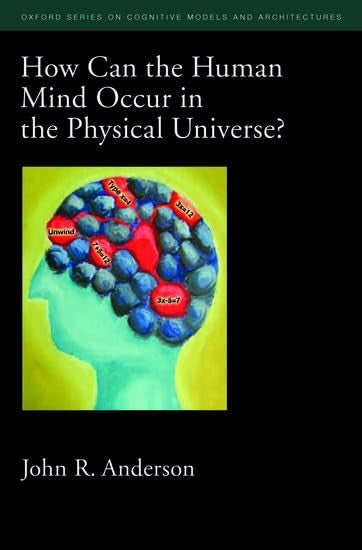
How Can the Human Mind Occur in the Physical Universe? by John R Anderson
The human cognitive architecture consists of a set of largely independent modules associated with different brain regions. This book discusses in detail how these various modules can combine to produce behaviours as varied as driving a car and solving an algebraic equation.
An eloquent, personal and closely argued book, that synthesizes decades of Anderson's ground-breaking work, integrates that work with the latest advances from brain imaging, and provides inspiration and direction for the future of cognitive scienceThis book puts cognitive architecture back at the heart of the subject, and provides a rich and coherent account of the computational machine that is the human brain. * Nick Chater, University College London, UK *
In this ground-breaking book, John Anderson brings together research on computational models of the mind and research on the operation of the brain. The book also provides the best description of the latest version of ACT, which is a significant extension in functionality and theory from its predecessors. The book is a must read for researchers and students in Cognitive Science. * John E. Laird, University of Michigan, USA *
In 2006 John Anderson received the world's major award in cognitive science, the Heineken Prize, for his groundbreaking theory on human cognition. His new book represents a courageous effort to further develop that theory; ambitious in its attempt to develop a coherent, general theory of human cognition of all of its physical, computational, and neuroscientific detail. It seems to me that the advanced tools of the present theory can, with great profit, be applied in meeting an ultimate challenge: explaining the role of language in human cognition. * Willem J. M. Levelt, Max Planck Institute for Psycholinguistics, Germany *
The mission of cognitive neuroscience is (or at least should be) to connect cognition with neural function, to explain how gray matter gives rise to the psychology of thought. Where many people settle for a mere geography - an inventory of what happens where - Anderson aims for something much more ambitious: an understanding of how cognition happens at all. By combining trenchant psychological analysis with well-motivated neuroimaging, Anderson provides a new paradigm for addressing the core questions in cognitive neuroscience. An important step in the science of relating mind and brain. * Gary Marcus, Infant Language Center, New York University, USA *
In this ground-breaking book, John Anderson brings together research on computational models of the mind and research on the operation of the brain. The book also provides the best description of the latest version of ACT, which is a significant extension in functionality and theory from its predecessors. The book is a must read for researchers and students in Cognitive Science. * John E. Laird, University of Michigan, USA *
In 2006 John Anderson received the world's major award in cognitive science, the Heineken Prize, for his groundbreaking theory on human cognition. His new book represents a courageous effort to further develop that theory; ambitious in its attempt to develop a coherent, general theory of human cognition of all of its physical, computational, and neuroscientific detail. It seems to me that the advanced tools of the present theory can, with great profit, be applied in meeting an ultimate challenge: explaining the role of language in human cognition. * Willem J. M. Levelt, Max Planck Institute for Psycholinguistics, Germany *
The mission of cognitive neuroscience is (or at least should be) to connect cognition with neural function, to explain how gray matter gives rise to the psychology of thought. Where many people settle for a mere geography - an inventory of what happens where - Anderson aims for something much more ambitious: an understanding of how cognition happens at all. By combining trenchant psychological analysis with well-motivated neuroimaging, Anderson provides a new paradigm for addressing the core questions in cognitive neuroscience. An important step in the science of relating mind and brain. * Gary Marcus, Infant Language Center, New York University, USA *
John R. Anderson is the R. K. Mellon University Professor of Psychology and Computer Science at Carnegie Mellon University. He has led the development of the ACT-R cognitive architecture and its applications, especially intelligent tutoring systems. Anderson has been recognized as a leader in the field of cognitive science by a number of awards, including the American Psychological Association's Distinguished Scientific Career Award, the David E. Rumelhart Prize for Contributions to the Formal Analysis of Human Cognition, the Howard Crosby Warren Medal for outstanding achievement in Experimental Psychology, and the Dr. A.H. Heineken Prize for Cognitive Science. He has been elected to the National Academy of Sciences and the American Academy of Arts and Sciences and is a past president of the Cognitive Science Society.
| SKU | Unavailable |
| ISBN 13 | 9780195324259 |
| ISBN 10 | 0195324250 |
| Title | How Can the Human Mind Occur in the Physical Universe? |
| Author | John R Anderson |
| Series | Oxford Series On Cognitive Models And Architectures |
| Condition | Unavailable |
| Binding Type | Hardback |
| Publisher | Oxford University Press Inc |
| Year published | 2007-09-06 |
| Number of pages | 304 |
| Cover note | Book picture is for illustrative purposes only, actual binding, cover or edition may vary. |
| Note | Unavailable |