
How Can the Human Mind Occur in the Physical Universe?


How Can the Human Mind Occur in the Physical Universe?
Regular price
Checking stock...
Regular price
Checking stock...
Summary
The argument John Anderson gives in this book was inspired by the passage above, from the last lecture by one of the pioneers of cognitive science. Newell describes what, for him, is the pivotal question of scientific inquiry, and Anderson gives an answer that is emerging from the study of brain and behavior.
The feel-good place to buy books
- Free US shipping over $15
- Buying preloved emits 41% less CO2 than new
- Millions of affordable books
- Give your books a new home - sell them back to us!
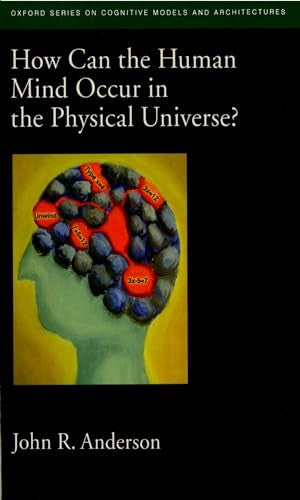
How Can the Human Mind Occur in the Physical Universe? by John R Anderson
'The question for me is how can the human mind occur in the physical universe. We now know that the world is governed by physics. We now understand the way biology nestles comfortably within that. The issue is how will the mind do that as well.' --Alan Newell, December 4, 1991, Carnegie Mellon University The argument John Anderson gives in this book was inspired by the passage above, from the last lecture by one of the pioneers of cognitive science. Newell describes what, for him, is the pivotal question of scientific inquiry, and Anderson gives an answer that is emerging from the study of brain and behavior. Humans share the same basic cognitive architecture with all primates, but they have evolved abilities to exercise abstract control over cognition and process more complex relational patterns. The human cognitive architecture consists of a set of largely independent modules associated with different brain regions. In this book, Anderson discusses in detail how these various modules can combine to produce behaviors as varied as driving a car and solving an algebraic equation, but focuses principally on two of the modules: the declarative and procedural. The declarative module involves a memory system that, moment by moment, attempts to give each person the most appropriate possible window into his or her past. The procedural module involves a central system that strives to develop a set of productions that will enable the most adaptive response from any state of the modules. Newell argued that the answer to his question must take the form of a cognitive architecture, and Anderson organizes his answer around the ACT-R architecture, but broadens it by bringing in research from all areas of cognitive science, including how recent work in brain imaging maps onto the cogntive architecture.
In this ground-breaking book, John Anderson brings together research on computational models of the mind and research on the operation of the brainThe book also provides the best description of the latest version of ACT, which is a significant extension in functionality and theory from its predecessors. The book is a must read for researchers and students in Cognitive Science. * John E. Laird, Professor, University of Michigan *
In 2006 John Anderson received the world's major award in cognitive science, the Heineken Prize, for his groundbreaking theory on human cognition. His new book represents a courageous effort to further develop that theory; ambitious in its attempt to develop a coherent, general theory of human cognition of all of its physical, computational, and neuroscientific detail. It seems to me that the advanced tools of the present theory can, with great profit, be applied in meeting an ultimate challenge: explaining the role of language in human cognition. * Willem J.M. Levelt, Director Emeritus, Max Planck Institute for Psycholinguistics *
The mission of cognitive neuroscience is (or at least should be) to connect cognition with neural function, to explain how gray matter gives rise to the psychology of thought. Where many people settle for a mere geography-an inventory of what happens where * Anderson aims for something much more ambitious: an understanding of how cognition happens at all. By combining trenchant psychological analysis with well-motivated neuroimaging, Anderson provides a new paradigm for addressing the core questions in cognitive neuroscience. An important step in the science of relating mind and brain.Gary Marcus, Professor of Psychology and Director, Infant Language Center, New York University *
An eloquent, personal and closely argued book, that synthesizes decades of Anderson's ground-breaking work, integrates that work with the latest advances from brain imaging, and provides inspiration and direction for the future of cognitive science. This book puts cognitive architecture back at the heart of the subject, and provides a rich and coherent account of the computational machine that is the human brain. * Nick Chater, Professor of Cognitive and Decision Sciences, University College, London *
In 2006 John Anderson received the world's major award in cognitive science, the Heineken Prize, for his groundbreaking theory on human cognition. His new book represents a courageous effort to further develop that theory; ambitious in its attempt to develop a coherent, general theory of human cognition of all of its physical, computational, and neuroscientific detail. It seems to me that the advanced tools of the present theory can, with great profit, be applied in meeting an ultimate challenge: explaining the role of language in human cognition. * Willem J.M. Levelt, Director Emeritus, Max Planck Institute for Psycholinguistics *
The mission of cognitive neuroscience is (or at least should be) to connect cognition with neural function, to explain how gray matter gives rise to the psychology of thought. Where many people settle for a mere geography-an inventory of what happens where * Anderson aims for something much more ambitious: an understanding of how cognition happens at all. By combining trenchant psychological analysis with well-motivated neuroimaging, Anderson provides a new paradigm for addressing the core questions in cognitive neuroscience. An important step in the science of relating mind and brain.Gary Marcus, Professor of Psychology and Director, Infant Language Center, New York University *
An eloquent, personal and closely argued book, that synthesizes decades of Anderson's ground-breaking work, integrates that work with the latest advances from brain imaging, and provides inspiration and direction for the future of cognitive science. This book puts cognitive architecture back at the heart of the subject, and provides a rich and coherent account of the computational machine that is the human brain. * Nick Chater, Professor of Cognitive and Decision Sciences, University College, London *
John Anderson received his B.A. from the University of British Columbia in 1968 and his Ph.D. from Stanford University 1972. He has been at Carnegie Mellon University since 1978 where he is a professor of psychology and computer science. His current research is concerned with developing the ACT-R theory of cognition and involves two related enterprises. One effort is concerned with modeling the acquisition of intellectual competences with major foci being the dynamic problem solving skills such as in air traffic control and mathematical problem solving skills. This research is also tied into efforts to develop computer-based instructional systems. The second effort is concerned with using fMRI brain imaging to track different components of the cognitive architecture in the performance of complex tasks.
| SKU | Unavailable |
| ISBN 13 | 9780195398953 |
| ISBN 10 | 0195398955 |
| Title | How Can the Human Mind Occur in the Physical Universe? |
| Author | John R Anderson |
| Series | Oxford Series On Cognitive Models And Architectures |
| Condition | Unavailable |
| Binding Type | Paperback |
| Publisher | Oxford University Press Inc |
| Year published | 2009-08-28 |
| Number of pages | 304 |
| Cover note | Book picture is for illustrative purposes only, actual binding, cover or edition may vary. |
| Note | Unavailable |