
HOW DO DINOSAURS LEARN TO READ?


World of Books
The feel-good place to buy books
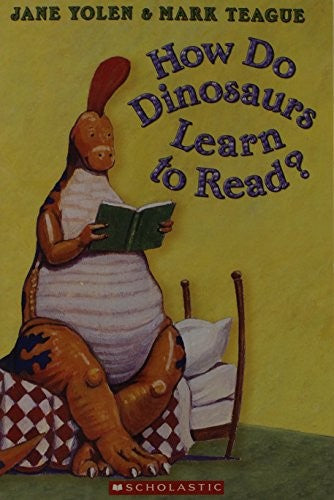
HOW DO DINOSAURS LEARN TO READ? by Jane Yolen
Part of the pleasure of this book is to reveal the provenance of the well-worn quote (or misquote)--my cup runneth over, ay, there's the rub, to err is human, the spice of life--but also to introduce some less familiar ones. Most of the quotations included are from classic sources--from the Bible, the works of Shakespeare, other poets, classical authors, Dickens (God bless us everyone, waiting for something to turn up, very humble), Charlotte Bronte (Reader, I married him) and George Bernard Shaw (who didn't actually say Youth is wasted on the young, but may have said something like it. Somewhere. No one seems to know for sure). This entertaining and informed--but not too serious--take on the wit and wisdom of the last 2000 years is ideal for modern readers who like their knowledge in tweet-sized chunks.Active in several organizations, Yolen has been on the Board of Directors of the Society of Children's Book Writers and Illustrators, was president of the Science Fiction Writers of America from 1986 to 1988, is on the editorial board of several magazines, and was a founding member of the Western New England Storytellers Guild, the Western Massachusetts Illustrators Guild, and the Bay State Writers Guild. For twenty years, she ran a monthly writer's workshop for new children's book authors. In 1980, when Yolen was awarded an honorary Doctor of Law degree by Our Lady of the Elms College in Chicopee, Massachusetts, the citation recognized that throughout her writing career she has remained true to her primary source of inspiration--folk culture. Folklore is the perfect second skin, writes Yolen. From under its hide, we can see all the shimmering, shadowy uncertainties of the world. Folklore, she believes, is the universal human language, a language that children instinctively feel in their hearts.
All of Yolen's stories and poems are somehow rooted in her sense of family and self. The Emperor and the Kite, which was a Caldecott Honor Book in 1983 for its intricate papercut illustrations by Ed Young, was based on Yolen's relationship with her late father, who was an international kite-flying champion. Owl Moon, winner of the 1988 Caldecott Medal for John Schoenherr's exquisite watercolors, was inspired by her husband's interest in birding.
Yolen's graceful rhythms and outrageous rhymes have been gathered in numerous collections. She has earned many awards over the years: the Regina Medal, the Kerlan Award, the World Fantasy Award, the Society of Children's Book Writers Award, the Mythopoetic Society's Aslan Award, the Christopher Medal, the Boy's Club Jr. Book Award, the Garden State Children's Book Award, the Daedalus Award, a number of Parents' Choice Magazine Awards, and many more. Her books and stories have been translated into Japanese, French, Spanish, Chinese, German, Swedish, Norwegian, Danish, Afrikaans, !Xhosa, Portuguese, and Braille.
With a versatility that has led her to be called America's Hans Christian Andersen, Yolen, the child of two writers, is a gifted and natural storyteller. Perhaps the best explanation for her outstanding accomplishments comes from Jane Yolen herself: I don't care whether the story is real or fantastical. I tell the story that needs to be told.
copyright ? 2000 by Penguin Putnam Books for Young Readers. All rights reserved.
| SKU | Unavailable |
| ISBN 13 | 9780439569842 |
| ISBN 10 | 0439569842 |
| Title | HOW DO DINOSAURS LEARN TO READ? |
| Author | Jane Yolen |
| Condition | Unavailable |
| Binding Type | Paperback |
| Publisher | Scholastic Inc. |
| Year published | 2003-01-01 |
| Number of pages | 6 |
| Cover note | Book picture is for illustrative purposes only, actual binding, cover or edition may vary. |
| Note | Unavailable |