
How the Soviet Union Disappeared


Summary
The feel-good place to buy books
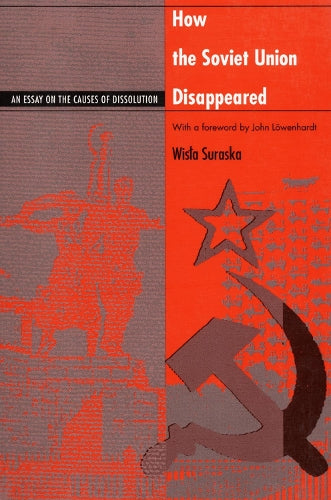
How the Soviet Union Disappeared by Wisla Suraska
Many theories have been offered to explain the disintegration of the Soviet Union, yet none sufficiently explain the speed and profundity of the empire’s collapse. In this powerful polemic, Wisla Suraska disputes popular interpretations of the dissolution of the Soviet Union and explains how theories, such as totalitarian theory, have failed to examine the exigencies of arbitrary government. At the center of Suraska’s own theories on the Soviet collapse is her claim that it came about not simply because it was an economically declining country that contained too many nationalities but because it was despotic and that despotism is unworkable in modern societies. Using numerous secondary sources, recently published memoir literature, and new archival research, Suraska’s multidimensional study delves into the many factors involved in the dissolution of the Soviet empire—the role of Gorbachev and his contest with Yeltsin, the weakness of the Soviet state, and the poverty of ideas that informed perestroika. She also examines the complex relationship between the Communist Party, the KGB, and the military; the way Gorbachev dealt with the German question; and the rise of post-Marxist thought in the Soviet Union. Whether discussing how insufficient control over coercive forces or the growing strength of provincial barons impacted the collapse, Suraska furthers her argument that the explosion of nationalisms in the Soviet Union was as much activated by the breakdown of central structures as it actually contributed to the final demolition of the regime. In the end, How the Soviet Union Disappeared reveals Gorbachev’s perestroika as having been nothing short of a radical attempt to rebuild power that the Soviet center had lost in the post-Stalinist period. In its questioning of the assumptions of most previous scholarship and discourse on the Soviet Union, this book will be of interest to Sovietologists, political scientists, and students of communism and nationalism.
“Suraska’s essay stands out as a towering example of clear thinking, based on the firm foundations of solid historical knowledge and creative theoretical interpretation”—from the Preface by John Löwenhardt, University of Glasgow
Wisla Suraska is visiting Fellow at the Robert Schuman Center, European University, Florence and senior researcher at the Adam Smith Research Center, Warsaw.
| SKU | Unavailable |
| ISBN 13 | 9780822321248 |
| ISBN 10 | 0822321246 |
| Title | How the Soviet Union Disappeared |
| Author | Wisla Suraska |
| Condition | Unavailable |
| Binding Type | Paperback |
| Publisher | Duke University Press |
| Year published | 1998-12-11 |
| Number of pages | 200 |
| Cover note | Book picture is for illustrative purposes only, actual binding, cover or edition may vary. |
| Note | Unavailable |