
The Idea of Commercial Society in the Scottish Enlightenment


Summary
The feel-good place to buy books
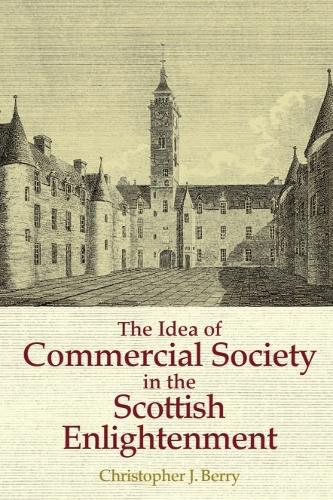
The Idea of Commercial Society in the Scottish Enlightenment by Christopher J Berry
The most arresting aspect of the Scottish Enlightenment is its conception of commercial society as a distinct and distinctive social formation. Christopher Berry explains why Enlightenment thinkers considered commercial society to be wealthier and freer than earlier forms, and charts the contemporary debates and tensions between Enlightenment thinkers that this idea raised. The book analyses the full range of literature on the subject, from key works like Adam Smith's 'Wealth of Nations', David Hume's 'Essays and Treatises on Several Subjects' and Adam Ferguson's 'Essay on the History of Civil Society' to lesser-known works such as Robert Wallace's 'Dissertation on Numbers of Mankind'.
Chris Berry is Professor Emeritus of Political Theory at the University of Glasgow, which he joined from 1970, from the LSE where he completed his doctorate. He is best known for his work on the Scottish Enlightenment and on the ‘Idea of Luxury’ and he has given invited keynote lectures on these themes in China, Japan, Chile, the US and in Europe. He is an elected Fellow of the Royal Society of Edinburgh.
| SKU | Unavailable |
| ISBN 13 | 9781474404716 |
| ISBN 10 | 1474404715 |
| Title | The Idea of Commercial Society in the Scottish Enlightenment |
| Author | Christopher J Berry |
| Condition | Unavailable |
| Binding Type | Paperback |
| Publisher | Edinburgh University Press |
| Year published | 2015-04-30 |
| Number of pages | 256 |
| Cover note | Book picture is for illustrative purposes only, actual binding, cover or edition may vary. |
| Note | Unavailable |