


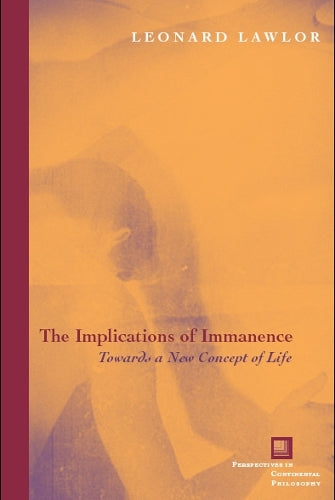
The Implications of Immanence by Leonard Lawlor
The Implications of Immanence develops a philosophy of life in opposition to the notion of "bio-power," which reduces the human to the question of power over what Giorgio Agamben terms "bare life," mere biological existence. Breaking with all biologism or vitalism, Lawlor attends to the dispersion of death at the heart of life, in the "minuscule hiatus" that divides the living present, separating lived experience from the living body and, crucially for phenomenology, inserting a blind spot into a visual field. Lawlor charts here a post-phenomenological French philosophy. What lies beyond phenomenology is "life-ism," the positive working out of the effects of the "minuscule hiatus" in a thinking that takes place on a "plane of immanence," whose implications cannot be predicted. Life-ism means thinking life and death together, thinking death as dispersed throughout life. In carefully argued and extensively documented chapters, Lawlor sets out the surpassing of phenomenology and the advent of life-ism in Merleau-Ponty, Derrida, and Foucault, with careful attention to the writings by Husserl and Heidegger to which these thinkers refer. A philosophy of life has direct implications for present-day political and medical issues. The book takes its point of departure from the current genocide in Darfur and provides conceptual tools for intervening in such issues as the AIDS epidemic and life-support for the infirm. Indeed, the investigations contained in The Implications of Immanence are designed to help us emerge once and for all out of the epoch of bio-power. "Lawlor's novel way of treating the concept of life is stimulating, original, and necessary for the social well being of our time."—Fred Evans, Duquesne University "The Implications of Immanence continues the most promising, rigorous, and fruitful ongoing research project among scholars of twentieth-century philosophy. . . .A wonderful new book."—John Protevi, Louisiana State University
"Seeking the implications of completing immanence, Lawlor proposes life-ism, an imperative from Merleau-Ponty 50 years ago, to find the principle of life-Book News "A fascinating and wide-ranging book that opens up new connections between the key movements of French philosophy in the second half of the 20th century." -- -Paul Patton University of New South Wales "A highly original and groundbreaking work." -- -Daniel W. Smith Purdue University
Leonard Lawlor is Sparks Professor of Philosophy at the Pennsylvania State University. He is the author of Derrida and Dusserl: The Basic Problem of Phenomenology; Thinking through French Philosophy: The Being of the Question; The Challenge of Bergsonism: Phenomenology, Ontology, Ethics; and Imagination and Chance: The Difference between the Thought of Ricoeur and Derrida.
| SKU | Unavailable |
| ISBN 13 | 9780823226542 |
| ISBN 10 | 0823226549 |
| Title | The Implications of Immanence |
| Author | Leonard Lawlor |
| Series | Perspectives In Continental Philosophy |
| Condition | Unavailable |
| Binding Type | Paperback |
| Publisher | Fordham University Press |
| Year published | 2006-12-15 |
| Number of pages | 192 |
| Cover note | Book picture is for illustrative purposes only, actual binding, cover or edition may vary. |
| Note | Unavailable |