
The Importance of Nietzsche


World of Books
The feel-good place to buy books
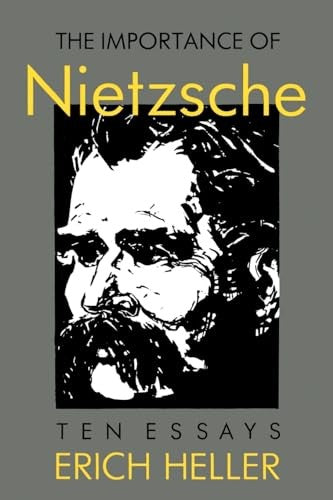
The Importance of Nietzsche by Erich Heller
In this book, one of the most distinguished scholars of German culture collects his essays on a figure who has long been one of his chief preoccupations. Erich Heller's lifelong study of modern European literature necessarily returns again and again to Friedrich Nietzsche. Nietzsche prided himself on having broken with all traditional ways of thinking and feeling, and once even claimed that he would someday be recognized for having ushered in a new millennium. While acknowledging Nietzsche's radicalism, Heller also insists on the continuity of the story in which he does indeed occupy a central place. By considering Nietzsche in relation to Goethe, Rilke, Wittgenstein, Yeats, and others, Heller shows the philosopher's ambivalence toward the tradition he inherited as well as his profound effect on the thought and sensibility of those who followed him. It is hardly an exaggeration to say, as Heller does in his first essay, that Nietzsche is to many modern writers and thinkers—including Mann, Musil, Kafka, Freud, Heidegger, Jaspers, Gide, and Sartre—what St. Thomas Aquinas was to Dante: the categorical interpreter of a world, which they contemplate imaginatively and theoretically without ever much upsetting its Nietzschean structure. Thus it is Nietzsche's thought, so pervasively present in the themes of modernity, that gives coherence and unity to Heller's essays. What emerges from them is that, despite his iconoclastic declarations and unorthodox philosophical practices, Nietzsche deals with the human spirit's persistent concerns. His questions remain urgent, and even the answers, in all their contradictoriness, possess the commanding force of his inquiry. An example is the incompatibility of the famous extremes, the teaching of the Übermensch and the Eternal Recurrence of All Things. These cancel each other out and yet grow from the same intellectual and spiritual roots, as is shown lucidly and cogently by one of Heller's most forceful essays, "Nietzsche's Terrors: Time and the Inarticulate." In fathoming the depth of this contradiction, Heller at the same time reveals the importance of Nietzsche for those who seek to understand the wellsprings of the epoch's disquiet, turmoil, and creativity.Erich Heller is an emeritus Avalon Professor of the Humanities at Northwestern University and the author of several works, including The Disinherited Mind and In the Age of Prose.
| SKU | Unavailable |
| ISBN 13 | 9780226326382 |
| ISBN 10 | 0226326381 |
| Title | The Importance of Nietzsche |
| Author | Erich Heller |
| Condition | Unavailable |
| Binding Type | Paperback |
| Publisher | The University of Chicago Press |
| Year published | 1988-12-15 |
| Number of pages | 210 |
| Cover note | Book picture is for illustrative purposes only, actual binding, cover or edition may vary. |
| Note | Unavailable |