


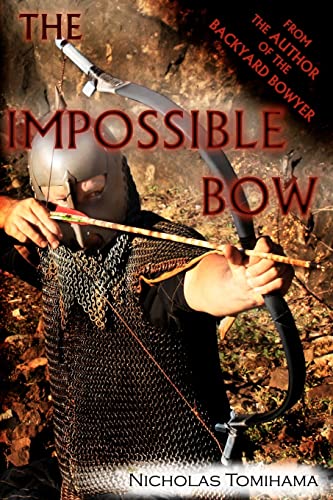
The Impossible Bow by Nicholas Tomihama
Archery is almost as old as mankind itself, manifesting in almost every culture and on almost every continent. It is in many ways our link to the past and the stepping stone into another age. It is one of the few ancient pastimes that are still relevant today. Yet nowadays, getting into the ancient sport of archery can be daunting for the average person with no experience or previous exposure to the subject. For many, the hefty price tags on modern bows or the seemingly impossible task of building a bow can be a surefire deterrent. Many do not want to pay the price of a decent bow to try their hand at the bow and arrow, simply to see if they enjoy it or not. If only there was a way to make a bow good enough for a beginner without expending or gambling an immense amount of time or money on it.
What if you were told that there was such a bow? That hidden in the ground, in the heart of buildings, on the shelves of most hardware stores, and perhaps even in your home, there was a material that made it all possible? Would you believe it? Well it is true, and that material is PVC pipe, the white or gray plastic pipe that can be found virtually everywhere. It is possible with only a minimal investment and an hour of labor to make a fine bow for target archery that performs just as well as bows worth more than ten times as much. A bow that, if given a little more time and effort, can be made into an efficient hunting tool or serious target shooter.
The Impossible Bow shows you how to construct your own PVC pipe bow, with bows ranging from the incredibly simple to the incredibly complex. Learn to build simple bows that require a minimum of tools and little time, more complex bows that can be modified to fit the target archer as well as the experienced hunter looking for more of a challenge, and finally a bow that accurately replicates the weapons of war of the steppe nomads. The best part is that even the most complex bow should cost no more than 10 dollars and be completed in a day, yet can hold up to the rigors of daily use.
Don't let anything hold you back from enjoying one of man's oldest and most noble of sports. Join the backyard archery revolution with your very own bow that will defy everything you know and will baffle anyone who sees it. Join me in building an impossible bow.
Author's Notes:
The bows in this book are great for kids of all ages, from the young to the young at heart. Because of the ability of these bows to mimic many historical bow designs, this book is great for re-enactment archery as well as for the target archer. If made well, one design in particular works well for hunting, and can be modified to work just as well as many primitive hunting bows. This book covers how to make the generic PVC pipe bow that has been the mainstay of do-it-yourself archery for some time now, as well as a couple designs which bring out the hidden performance of PVC as a bow material.
These bows also work well for survival situations and can be made small and can be kept virtually anywhere out of the sun. In the trunk of a car, in a boat, in a hunting cabin, your basement, your attic, the list goes on and on. This book goes over how to make smooth shooting bows from 30 to 70 pounds of pull that can perform well if taken care of. While they aren't top performing bows, they can certainly be used for hunting, fishing, and target archery.
Nicholas Ikaika Tomihama was born and reared in the Hawaiian capital of Honolulu. He used to spend his leisure time as a child making his own toys out of various household things, which often resulted in messes and small pandemonium. At the age of five, he fashioned his first bow out of steel coat hangers that had been straightened and tied together with a rubber-band string. His father, a former president of the Hawaii Jeweler's Association and a retired jeweler, fostered his wandering interests in making things. Nicholas had a childhood fascination with archery, and when he was ten, his father purchased him his first bow, a lil' Banshee compound.
Nicholas started his own business at the age of 14 with the aid of his father, making and selling handcrafted Koa wood pens. During this time, he tried his hand at making knives and spears, as well as steel arrowheads on occasion. He was uninterested in archery in high school and met his future wife Angela during his senior year at Mid-Pacific Institute. Following graduation, he enrolled at the University of Hawaii at Hilo to pursue a degree in Business Administration.
He returned to Honolulu after a semester and an internal awakening of a yearning for the primitive. After he returned home, he began seeking for work and was recruited as a Home Meal Processor by Sam's Club. He attempted to create a bespoke knifemaking business with a job and a fiance, but it failed to get off the ground. Nicholas was unable to produce knives or pens after moving out of his parent's house and losing access to his father's arsenal of power tools.
He switched up archery, using his father's fiberglass hunting recurve bow, since he was bored. He began creating his own bows with rudimentary hand tools after a few months of shooting, training himself as he went. After some time, he was approached by a buddy who requested that he create a bow for him. It was snapped when another friend yanked it too hard, but no one was hurt.
Following that, he prayed and asked God for guidance. He had always manufactured things to sell, but after much prayer, he realized he was called to something more. He continued to make bows in his backyard and ultimately taught a few others how to do the same. With that expertise under his belt, he began writing the Backyard Bowyer to assist others who were interested in creating bows but didn't know where to begin.
| SKU | Unavailable |
| ISBN 13 | 9780983248156 |
| ISBN 10 | 098324815X |
| Title | The Impossible Bow |
| Author | Nicholas Tomihama |
| Condition | Unavailable |
| Binding Type | Paperback |
| Publisher | Levi Dream |
| Year published | 2011-09-19 |
| Number of pages | 304 |
| Cover note | Book picture is for illustrative purposes only, actual binding, cover or edition may vary. |
| Note | Unavailable |