


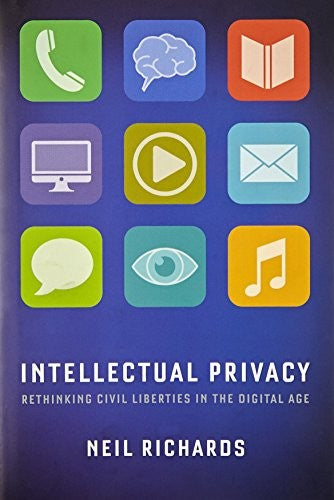
Intellectual Privacy by Neil Richards
Most people believe that the right to privacy is inherently at odds with the right to free speech. Courts all over the world have struggled with how to reconcile the problems of media gossip with our commitment to free and open public debate for over a century. The rise of the Internet has made this problem more urgent. We live in an age of corporate and government surveillance of our lives. And our free speech culture has created an anything-goes environment on the web, where offensive and hurtful speech about others is rife. How should we think about the problems of privacy and free speech? In Intellectual Privacy, Neil Richards offers a different solution, one that ensures that our ideas and values keep pace with our technologies. Because of the importance of free speech to free and open societies, he argues that when privacy and free speech truly conflict, free speech should almost always win. Only when disclosures of truly horrible information are made (such as sex tapes) should privacy be able to trump our commitment to free expression. But in sharp contrast to conventional wisdom, Richards argues that speech and privacy are only rarely in conflict. America's obsession with celebrity culture has blinded us to more important aspects of how privacy and speech fit together. Celebrity gossip might be a price we pay for a free press, but the privacy of ordinary people need not be. True invasions of privacy like peeping toms or electronic surveillance will rarely merit protection as free speech. And critically, Richards shows how most of the law we enact to protect online privacy pose no serious burden to public debate, and how protecting the privacy of our data is not censorship. More fundamentally, Richards shows how privacy and free speech are often essential to each other. He explains the importance of 'intellectual privacy,' protection from surveillance or interference when we are engaged in the processes of generating ideas - thinking, reading, and speaking with confidantes before our ideas are ready for public consumption. In our digital age, in which we increasingly communicate, read, and think with the help of technologies that track us, increased protection for intellectual privacy has become an imperative. What we must do, then, is to worry less about barring tabloid gossip, and worry much more about corporate and government surveillance into the minds, conversations, reading habits, and political beliefs of ordinary people. A timely and provocative book on a subject that affects us all, Intellectual Privacy will radically reshape the debate about privacy and free speech in our digital age.
Intellectual Privacy is a book that every privacy scholar needs to read and a book that deserves a much wider readership than thatThough it is a legal book the detailed legal and historical analyses that Richards provides throughout the book are scholarly and yet accessible it has implications well beyond the law, from business practices to personal responsibilities. * Paul Bernal, International Data Privacy Law *
This book brings fresh perspective and some clear ideas to privacy law and its interaction with freedom of speech. This book is stimulating and thought-provoking, and is recommended for those with an interest in privacy, free speech, and the interplay of those with technological innovation. * Arye Schreiber, The Cambridge Law Journal *
After tracking the origins of privacy theory and showing how the original idea, as promoted by Samuel Warren and Louis Brandeis, was flawed at its conception and misapplied over time, Richards carefully constructs a theory about the incubation of new ideas and explains that respect for privacy allows for intellectual exploration and development. This later section, in which Richards moves away from parsing court decisions in favor of a broader philosophical inquiry, is the heart of the book and stands as its main and important contribution to the literature. * S. B. Lichtman, Shippensburg University, CHOICE *
This book brings fresh perspective and some clear ideas to privacy law and its interaction with freedom of speech. This book is stimulating and thought-provoking, and is recommended for those with an interest in privacy, free speech, and the interplay of those with technological innovation. * Arye Schreiber, The Cambridge Law Journal *
After tracking the origins of privacy theory and showing how the original idea, as promoted by Samuel Warren and Louis Brandeis, was flawed at its conception and misapplied over time, Richards carefully constructs a theory about the incubation of new ideas and explains that respect for privacy allows for intellectual exploration and development. This later section, in which Richards moves away from parsing court decisions in favor of a broader philosophical inquiry, is the heart of the book and stands as its main and important contribution to the literature. * S. B. Lichtman, Shippensburg University, CHOICE *
Professor of Law, Washington University-St. Louis
| SKU | Unavailable |
| ISBN 13 | 9780199946143 |
| ISBN 10 | 0199946140 |
| Title | Intellectual Privacy |
| Author | Neil Richards |
| Condition | Unavailable |
| Binding Type | Hardback |
| Publisher | Oxford University Press Inc |
| Year published | 2015-03-05 |
| Number of pages | 240 |
| Cover note | Book picture is for illustrative purposes only, actual binding, cover or edition may vary. |
| Note | Unavailable |