
Introducing Linguistic Morphology


Summary
The feel-good place to buy books
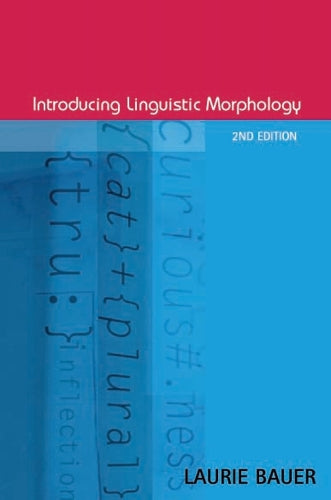
Introducing Linguistic Morphology by Laurie Bauer
An expanded and updated new edition of this best-selling introduction to linguistic morphology. The text guides the reader from the very first principles of the internal structure of words through to advanced issues of current controversy.
This revision of Laurie Bauer's popular textbook is most welcomeLike the first edition it's clear, reliable and interesting, but it's been updated to take account of the new interest in morphology. New chapters provide an excellent way into recent work informed by non-linear phonology, by diachronic typology and - most interesting of all - by psycholinguistics. Anyone who wants a quick explanation of grammaticalisation, autosegmental morphology or the dual-route theory need look no further. The book also gains from the new exercises and three appendices (including a glossary). An excellent book for the student who really wants to understand. -- Dick Hudson, Professor of Linguistics, University College London In the second edition of this well-known textbook, Laurie Bauer provides a thorough introduction to such basic notions as segmentability, the nature of the word-form, inflection vs. derivation and productivity of patterns and processes, carefully discussing controversial issues in each case, using examples that students may well encounter early when they confront the more technical literature. In this area, there is arguably no single dominant theoretical approach, so he is at pains to present both lexicalist and word-and-paradigm morphology, to contrast them, and to show that natural morphology, an approach with rather different goals, is broadly compatible with both. New chapters and sections of others deal with new proposals arising from the problematic status of the morpheme, with non-linear morphology (an approach developed more fully since the first edition), with the historical status of morphology in grammar, and with the relations between the constructs of theoretical morphology and psycholinguistic processes. All these are clearly introduced and the reasons for controversy spelt out. The result is an accessible handy and reliable comprehensive guide to the basics. There are useful suggestions for further reading, and appendices containing quite challenging questions for reflection and a recapitulation with worked examples of some of the key concepts. -- Richard Coates, Professor of Linguistics, University of Sussex This revision of Laurie Bauer's popular textbook is most welcome. Like the first edition it's clear, reliable and interesting, but it's been updated to take account of the new interest in morphology. New chapters provide an excellent way into recent work informed by non-linear phonology, by diachronic typology and - most interesting of all - by psycholinguistics. Anyone who wants a quick explanation of grammaticalisation, autosegmental morphology or the dual-route theory need look no further. The book also gains from the new exercises and three appendices (including a glossary). An excellent book for the student who really wants to understand. In the second edition of this well-known textbook, Laurie Bauer provides a thorough introduction to such basic notions as segmentability, the nature of the word-form, inflection vs. derivation and productivity of patterns and processes, carefully discussing controversial issues in each case, using examples that students may well encounter early when they confront the more technical literature. In this area, there is arguably no single dominant theoretical approach, so he is at pains to present both lexicalist and word-and-paradigm morphology, to contrast them, and to show that natural morphology, an approach with rather different goals, is broadly compatible with both. New chapters and sections of others deal with new proposals arising from the problematic status of the morpheme, with non-linear morphology (an approach developed more fully since the first edition), with the historical status of morphology in grammar, and with the relations between the constructs of theoretical morphology and psycholinguistic processes. All these are clearly introduced and the reasons for controversy spelt out. The result is an accessible handy and reliable comprehensive guide to the basics. There are useful suggestions for further reading, and appendices containing quite challenging questions for reflection and a recapitulation with worked examples of some of the key concepts.
Laurie Bauer is Professor of Linguistics at the Victoria University of Wellington. He is on the editorial board of the journal Word Structure.
| SKU | Unavailable |
| ISBN 13 | 9780748617050 |
| ISBN 10 | 0748617051 |
| Title | Introducing Linguistic Morphology |
| Author | Laurie Bauer |
| Condition | Unavailable |
| Binding Type | Paperback |
| Publisher | Edinburgh University Press |
| Year published | 2003-06-06 |
| Number of pages | 384 |
| Cover note | Book picture is for illustrative purposes only, actual binding, cover or edition may vary. |
| Note | Unavailable |