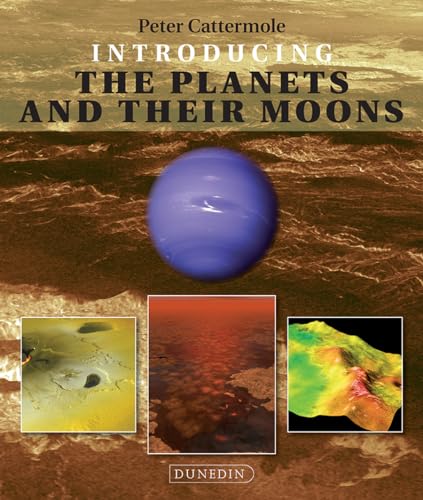
Introducing the Planets and their Moons by Peter Cattermole
A comprehensive, highly illustrated and scientifically sound adult introduction to the solar system reflecting modern research.You might also like


Nature Anatomy

Little Kids First Big Book of Animals

USA National Parks
Ocean Anatomy

American Buffalo



I'm Still Here

Dog Training for Kids


The Complete Guide to Edible Wild Plants





Safari

The The Invisible Leash

-
 Introducing Geology
-
 Introducing Palaeontology
-
 Introducing Oceanography
-
 Introducing Meteorology
-
 Introducing Geomorphology
-
 Introducing Volcanology
-
 Introducing Sedimentology
-
 Introducing Metamorphism
-
 Introducing Hydrogeology
-
 Introducing Tectonics, Rock Structures and Mountain Belts
-
 Introducing Mineralogy
-
 Introducing Sea Level Change
-
 Introducing Geophysics
-
 Introducing Natural Resources
-
 Introducing Astronomy


'This little book is full of detailed information, anticipating the current Rosetta exploration of the comet 67P (12/11/2014) together with continuing and future exploratory programmes
There are 12 basic chapters, a full list of tables and illustrations, a useful glossary and a list of books for further reading. Many of the illustrations are from NASA and JPL, including Hubble Space Telescope photographs and artist illustrations. A helpful addition would be diagrams of the relative positions of each set of planet with its moons.
There are detailed descriptions of the surface features and analyses of the compositions of each planet and moon, as far as is possible to date. In some cases the analysis has been from actual samples, such as those from the Earth’s Moon and from Mars.
Rather than take each planet separately, each chapter makes comparisons of the planets. Chapter 1 is a general descriptive introduction; Ch. 2 describes the probable origin of the Solar System; Ch. 3 introduces the Planets and their orbits; Ch. 4 discusses planetary differentiation; Ch. 5 describes the magnetic fields; Ch. 6 planetary atmospheres; Ch. 7 geological development of the inner planets; and Ch. 8 volcanism within the inner Solar System. The Earth’s moon is discussed in Ch. 9; Ch. 10 covers the outer planets; Ch. 11 the moons of Jupiter and Saturn; and Ch. 12 the moons of Uranus and Neptune.
I would recommend this book to anyone looking for detailed and up-to-date information (as at March 2014) to complement other studies. It is written well by a man who worked with NASA. As he says, it is not an exhaustive treatment, but rather intended to inspire readers to investigate more of the subject.'
The Open University Geological Society Journal
‘…this is a really good read. By the end of it, you'll either have the basics that you need to make sense of our solar system, or you'll be fired up and wanting to know much more. Surely that's what a good introductory book should be about. In which case this book does its job perfectly!Peter Cattermole describes the characteristics and geological development of the eight large planetary bodies and their more substantial moons. This includes discussion of their orbital properties, magnetic fields, atmospheres and mutual interactions. Rather than deal with the system planet by planet, his approach is comparative. Thus one chapter deals with planetary orbits, another with planetary differentiation and a third with volcanism. This enables the reader to perceive immediately how their position and size led these bodies along different evolutionary paths.’Down to Earth
Peter Cattermole was a lecturer in planetary geology and igneous petrology at the Universities of Wales and Sheffield. For many years he was a Principal Investigator on NASA’s Planetary Geology and Geophysics Program, studying the volcanoes of Mars and Venus.
| SKU | Unavailable |
| ISBN 13 | 9781780460291 |
| ISBN 10 | 1780460295 |
| Title | Introducing the Planets and their Moons |
| Author | Peter Cattermole |
| Series | Introducing Earth And Environmental Sciences |
| Condition | Unavailable |
| Binding Type | Paperback |
| Publisher | Liverpool University Press |
| Year published | 2014-09-04 |
| Number of pages | 152 |
| Cover note | Book picture is for illustrative purposes only, actual binding, cover or edition may vary. |
| Note | Unavailable |
Customers who bought this item also bought
Nature Anatomy
Little Kids First Big Book of Animals
USA National Parks
Ocean Anatomy
American Buffalo
I'm Still Here
Dog Training for Kids
The Complete Guide to Edible Wild Plants
Safari
The The Invisible Leash

Birds of Florida Field Guide
The Wonder of Seashells



Bird Trivia

The Other End of the Leash

The Forager's Harvest

Inside of a Dog

Doggie Language

The Hidden Life of Trees

Puppy Primer

The Big Book of Tricks for the Best Dog Ever

The Man Who Planted Trees



Zak George's Dog Training Revolution

The Hummingbird Handbook

The Amazing Afterlife of Animals

How to Forage for Mushrooms without Dying


Mushrooms of the Northeast

The Rise and Reign of the Mammals


Birds of Colorado Field Guide

Unlikely Loves

Perfect Puppy in 7 Days