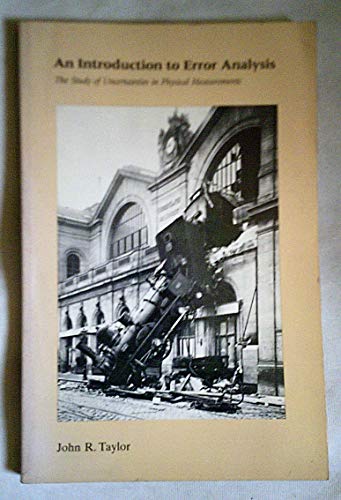
An Introduction to Error Analysis by John R Taylor

An Introduction to Error Analysis by John R Taylor

Regular price
Checking stock...
Regular price
Checking stock...
World of Books

At World of Books, you’ll find millions of preloved reads at great prices, from bestsellers to hidden gems. Every book you buy saves money and helps reduce waste, so you can read more for less while giving stories a second life.

The feel-good place to buy books
  • Free US shipping over $15
  • Buying preloved emits 41% less CO2 than new
  • Millions of affordable books
  • Give your books a new home - sell them back to us!

An Introduction to Error Analysis by John R Taylor

This remarkable text by John R. Taylor has been a non-stop best-selling international hit since it was first published forty years ago. However, the two-plus decades since the second edition was released have seen two dramatic developments; the huge rise in popularity of Bayesian statistics, and the continued increase in the power and availability of computers and calculators. In response to the former, Taylor has added a full chapter dedicated to Bayesian thinking, introducing conditional probabilities and Bayes' theorem. The several examples presented in the new third edition are intentionally very simple, designed to give readers a clear understanding of what Bayesian statistics is all about as their first step on a journey to become practicing Bayesians. In response to the second development, Taylor has added a number of chapter-ending problems that will encourage readers to learn how to solve problems using computers. While many of these can be solved using programs such as Matlab or Mathematica, almost all of them are stated to apply to commonly available spreadsheet programs like Microsoft Excel. These programs provide a convenient way to record and process data and to calculate quantities like standard deviations, correlation coefficients, and normal distributions; they also have the wonderful ability - if students construct their own spreadsheets and avoid the temptation to use built-in functions - to teach the meaning of these concepts.

This remarkable text by John R. Taylor has been a non-stop best-selling international hit since it was first published forty years ago. However, the two-plus decades since the second edition was released have seen two dramatic developments; the huge rise in popularity of Bayesian statistics, and the continued increase in the power and availability of computers and calculators. In response to the former, Taylor has added a full chapter dedicated to Bayesian thinking, introducing conditional probabilities and Bayes' theorem. The several examples presented in the new third edition are intentionally very simple, designed to give readers a clear understanding of what Bayesian statistics is all about as their first step on a journey to become practicing Bayesians. In response to the second development, Taylor has added a number of chapter-ending problems that will encourage readers to learn how to solve problems using computers. While many of these can be solved using programs such as Matlab or Mathematica, almost all of them are stated to apply to commonly available spreadsheet programs like Microsoft Excel. These programs provide a convenient way to record and process data and to calculate quantities like standard deviations, correlation coefficients, and normal distributions; they also have the wonderful ability - if students construct their own spreadsheets and avoid the temptation to use built-in functions - to teach the meaning of these concepts.

SKU Unavailable
ISBN 13 9780935702101
ISBN 10 0935702105
Title An Introduction to Error Analysis
Author John R Taylor
Condition Unavailable
Binding Type Paperback
Publisher University Science Books,U.S.
Year published 1982-01-01
Number of pages 270
Cover note Book picture is for illustrative purposes only, actual binding, cover or edition may vary.
Note Unavailable