


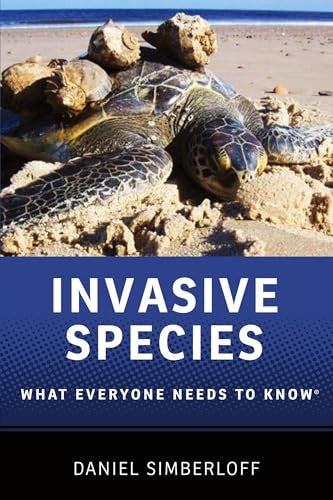
Invasive Species by Daniel Simberloff
Of the 7,000 estimated non-native species present in North America, approximately 1,000 are invasive. Clearly, invasive species are in the minority, but their small numbers don't keep them from causing billions of dollars in economic and ecological harm each year. Policymakers and ecologists continue to try to figure out which species might be harmful, which invasive species are doing the most damage, and which of these might respond best to eradication efforts. Invasive species reports and case studies are prevalent in political, environmental, and scientific news cycles, and a significant portion of the public is concerned about the issue. In Invasive Species: What Everyone Needs to Know, Daniel Simberloff will discuss how non-native species are introduced, which areas have incurred the most biological invasions, and how the rates of biological invasions have shifted in recent years. He analyzes the direct and indirect impacts of the impacts of invasive species on various ecosystems, such as habitat and resource competition, how invasive species transmit pathogens, and how introduced plants and animals can modify a habitat to favor other non-native species. Simberloff's final chapters will discuss the evolution of invasive species, the policies we currently have in place to manage them, and future prospects for controlling their spread. The book will also contain a section dedicated to the more controversial topics surrounding invasive species: invasive natives, useful non-native species, animal rights versus species rights, and non-native species' impacts on the biodiversity of an ecosystem.
"Written for nonexpert but educated readers, Invasive Species will reward those who demand well-documented information without requiring scientific detailsBy extending his wide-ranging survey of biological invasions beyond their biology, Simberloff acknowledges the crucial human dimensions of invasive species." -- Science "Most interesting are discussions on the transport and spread of invasive species during ancient human migrations. Reflecting the author's unbiased writing, the book includes a chapter on the controversies surrounding the science and regulation of invasive species. Recommended." -B.R. Shmaefsky, Lone Star College - Kingwood, CHOICE "Simberloff's narrative style clearly communicates the natural processes operating in invasion biology, along with the immense magnitude of invasion damages." -- Biological Conservation "...probably the most comprehensive and easy-to-read mini-volume to tackle the enormous topic of biological invasions, and a useful springboard for further reading." -- Michael Stastny, University of Ottawa, The Quarterly Review of Biology
Daniel Simberloff is the Nancy Gore Hunger Professor of Environmental Studies and Director of the Institute for Biological Invasions at the University of Tennessee. He is the author of approximately 500 publications on ecology, biogeography, evolution, and conservation biology; much of his research focuses on causes and consequences of biological invasions. He is senior editor of the Encyclopedia of Biological Invasions (University of California Press, 2011), editor-in-chief of Biological Invasions, associate editor of the Annual Review of Ecology, Evolution, and Systematics, and serves on the editorial boards of several other journals. In 2006 he was named Eminent Ecologist by the Ecological Society of America.
| SKU | Unavailable |
| ISBN 13 | 9780199922031 |
| ISBN 10 | 0199922039 |
| Title | Invasive Species |
| Author | Daniel Simberloff |
| Series | What Everyone Needs To Know |
| Condition | Unavailable |
| Binding Type | Paperback |
| Publisher | Oxford University Press Inc |
| Year published | 2013-10-31 |
| Number of pages | 352 |
| Cover note | Book picture is for illustrative purposes only, actual binding, cover or edition may vary. |
| Note | Unavailable |