


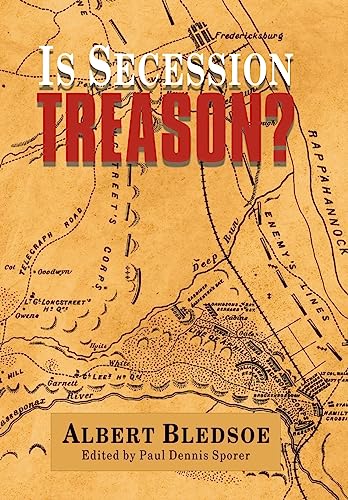
Is Secession Treason? by Albert Bledsoe
General Robert E. Lee uttered to Albert Bledsoe these important words: You have a great work to do; we all look to you for our vindication. The work Lee was referring to was in essence a Confederate political bible, that would clarify and explain the principles of self-determination upon which the Secession from the United States of America was based. Bledsoe was truly inspired to write a most deftly argued book defending the South's unthinkable action. This treatise, originally called Is Davis a Traitor?, is finally returned to print in a new edition, with a new preface and index. Albert Taylor Bledsoe (1809-1877) could be characterized as a traditionalist, an unreconstructed Southerner, a fighter for various causes and a firm believer in the dangers of modernism and foreign influence. Yet he was no stooge working for the Southern Brahmins- he was an intelligent man of letters, soldier and educator, clergyman and lawyer, friend of wealthy men, social investigator, and seasoned traveler. Because of his intellectual perspicacity, and his connections to important leaders in the South, he became an apologist for the Southern Confederacy, and the pre-war Southern mentality. Is Secession Treason? represents the pinnacle of Bledsoe's work. The centerpiece of his position is the critical distinction between the words constitution and compact. Drawing from the texts of numerous political and philosophical documents, he presents ample justification for the assertion that the union of former colonies in the 1780s was voluntary and not perpetual, and their inherent independence was not taken away by their acceding to the compact that joined them. Limitation on the power of the central authority over the states was actually a key factor in the minds of the participants attending the Constitutional Convention, as the author so ably proves. In the pursuit of honesty and openness, Bledsoe strives to present both sides of the debate, and states with great clarity and force the positions of Webster, Madison, Jefferson, Hamilton, Calhoun and many others. After careful reflection and analysis, he arrives at two powerful conclusions: Secession was allowed under the Constitution, and the military attack by the Federal government on the Confederacy was illegal. So well-reasoned were his arguments, that his book proved to be a source of material for the defense of Jefferson Davis, President of the Southern Confederacy, from charges of treason. Despite Albert Bledsoe's unwavering devotion to his beloved homeland, one could say that his treatise is more of a fair and balanced treatment of Secession, than many recently published works covering the same subject.
Albert Taylor Bledsoe was born in Kentucky in 1807. After graduating from West Point Academy, he becae an Episcopal minister in 1835. He resigned from the ministry and spent the next nine years practicing law in Springfield, Illinois. A member of the Whig party, he served as chief editor of the Illinois State Journal, which was the town's principal Whig newspaper. Bledsoe left Springfield in 1848 to become professor of mathematics, first at the University of Mississippi until 1854 and then at the University of Virginia until the outbreak of the Civil War in 1861. He served during the war as acting Assistant Secretary of War in Richmond. After the war, Bledsoe published numerous books and other materials in defense of the Confederate cause, and he founded and also edited the Southern Review until his death on December 8, 1877 in Alexandria, Virginia. He was buried at the University of Virginia.
| SKU | Unavailable |
| ISBN 13 | 9781932490190 |
| ISBN 10 | 1932490191 |
| Title | Is Secession Treason? |
| Author | Albert Bledsoe |
| Condition | Unavailable |
| Binding Type | Hardback |
| Publisher | Anza Publishing |
| Year published | 2005-12-08 |
| Number of pages | 240 |
| Cover note | Book picture is for illustrative purposes only, actual binding, cover or edition may vary. |
| Note | Unavailable |