


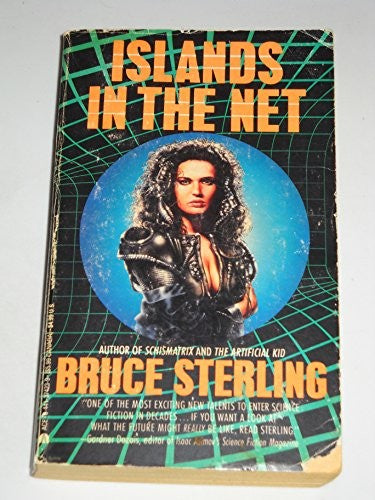
Islands in the Net by Bruce Sterling
In a near-future new age of corporate control, hacker mercenaries, and electronic terrorism, a public relations executive on the rise finds herself caught in the violent epicenter of a data war.
Two decades into the twenty-first century, the world's nations are becoming irrelevant. Corporations are the true global powers, with information the most valuable currency, while the smaller island nations have become sanctuaries for data pirates and terrorists. A globe-trotting PR executive for the large corporate economic democracy Rizome Industries Group, Laura Webster is present when a foreign representative is assassinated on Rizome soil during a conference for offshore data havens. Dispatched immediately on an international mission of diplomacy, Laura hopes she can make a difference in a volatile, unsteady world, but instead finds herself trapped on the front lines of rapidly escalating third-world hostilities and caught up in an inescapable net of conspiracy, terrorism, post-millennial voodoo, and electronic warfare.
During the 1980s, science fiction luminary Bruce Sterling envisioned the future . . . and hit it almost dead-on. The author who, along with William Gibson, Neal Stephenson, and Rudy Rucker, helped create and define the cyberpunk subgenre imagines a world of tomorrow in Islands in the Net that bears a striking--and disturbing--resemblance to our present-day information-age reality. Nominated for the Hugo and Locus Awards and winner of the John W. Campbell Memorial Award, Sterling's extraordinary novel is a gripping, eye-opening, and remarkably prescient science fiction classic.
In the 1980s, Bruce Sterling became a leader of the 'cyberpunk' revolution -- a literary movement that combined the artistic ambition of science fiction's 1960s New Wave with the hard-core speculation associated with Verne, Wells, Heinlein, and Clarke. Cyberpunk's chief theme was the way technologies evolve us even as we evolve them, and its influence can be seen in almost every science fiction writer of note today, from Ken MacLeod to Alastair Reynolds to Cory Doctorow. Neuromancer author William Gibson may have been the best-known of the cyberpunks, but the movement's chief theorist and propagandist was Sterling, whose writing covered far more territory than that of his peers.... Sterling lives in Austin, Texas. He is a design professor at the moment -- the Visionary in Residence at the Art Center College of Design in Pasadena, California. He has appeared on Nightline, The Late Show, MTV, and is the author of nine novels, three of which were selected as New York Times Notable Books of the Year. The Difference Engine, co-written with William Gibson, was a national bestseller. He has also published three short-story collections and two nonfiction books. He has written for many magazines, including Newsweek, Fortune, Harper's, Details, Whole Earth Review, and Wired, where he has been a contributing writer since its inception. He does public speaking as a hobby, and has addressed academics, market experts, experimental media groups, phone regulators, state bureaucrats, and architects, among others.
| SKU | Unavailable |
| ISBN 13 | 9780441374236 |
| ISBN 10 | 0441374239 |
| Title | Islands in the Net |
| Author | Bruce Sterling |
| Condition | Unavailable |
| Binding Type | Paperback |
| Publisher | Penguin Putnam Inc |
| Year published | 1989-03-01 |
| Number of pages | 396 |
| Cover note | Book picture is for illustrative purposes only, actual binding, cover or edition may vary. |
| Note | Unavailable |