


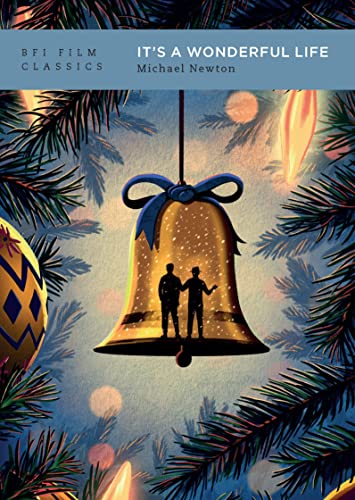
It's a Wonderful Life by Michael Newton
Frank Capra's It's a Wonderful Life is one of the best-loved films of Classical Hollywood cinema, a story of despair and redemption in the aftermath of war that is one of the central movies of the 1940s, and a key text in America’s understanding of itself. This is a film that remains relevant to our own anxieties and yearnings, to all the contradictions of ordinary life, while also enacting for us the quintessence of the classic Hollywood aesthetic. Nostalgia, humour, and a tough resilience weave themselves through this movie, intertwining it with the fraught cultural moment of the end of World War II that saw its birth. It offers a still compelling merging of fantasy and realism that was utterly unique when it was first released, and has rarely been matched since. Michael Newton's study of the film investigates the source of its extraordinary power and its long-lasting impact. He begins by introducing the key figures in the movie’s production - notably director Frank Capra and star James Stewart - and traces the making of the film, and then provides a brief synopsis of the film, considering its aesthetic processes and procedures, touching on all those things that make it such an astonishing film. Newton's careful analysis explores all those aspects of the film that are fundamental to our understanding of it, particularly the way in which the film brings tragedy and comedy together. Finally, Newton tells the story of the film’s reception and afterlife, accounting for its initial relative failure and its subsequent immense popularity.
Michael Newton’s story of the making of Frank Capra’s 1946 movie is full of quirky facts-- Martin Chilton * The Independent *
Digging into the film’s roots and post-war background, Newton is rigorous on its politics, populism and fraught production history, and generous with the minutiae of on-set accidents and more. But what emerges clearest is Capra’s abiding faith in feeling and beauty. -- Kevin Harley * Total Film *
Michael Newton’s excellent study, part of the BFI’s Film Classics series, looks at the movie’s creation, the vital contributions of Capra and the film’s star, James Stewart, a brief summary of the plot and an examination of why it has proved to be so enduring. * Choice *
Digging into the film’s roots and post-war background, Newton is rigorous on its politics, populism and fraught production history, and generous with the minutiae of on-set accidents and more. But what emerges clearest is Capra’s abiding faith in feeling and beauty. -- Kevin Harley * Total Film *
Michael Newton’s excellent study, part of the BFI’s Film Classics series, looks at the movie’s creation, the vital contributions of Capra and the film’s star, James Stewart, a brief summary of the plot and an examination of why it has proved to be so enduring. * Choice *
Michael Newton is Lecturer in English at Leiden University, Netherlands. He is the author of Savage Girls and Wild Boys: A History of Feral Children (2002), Age of Assassins: A History of Conspiracy and Political Violence, 1865-1981 (2012), and of Kind Hearts and Coronets (2003) and Rosemary's Baby (2020) in the BFI Film Classics series.
| SKU | Unavailable |
| ISBN 13 | 9781839023484 |
| ISBN 10 | 1839023481 |
| Title | It's a Wonderful Life |
| Author | Michael Newton |
| Series | Bfi Film Classics |
| Condition | Unavailable |
| Binding Type | Paperback |
| Publisher | Bloomsbury Publishing PLC |
| Year published | 2023-09-07 |
| Number of pages | 168 |
| Cover note | Book picture is for illustrative purposes only, actual binding, cover or edition may vary. |
| Note | Unavailable |