
James Agee, Omnibus, and Mr. Lincoln


Summary
The feel-good place to buy books
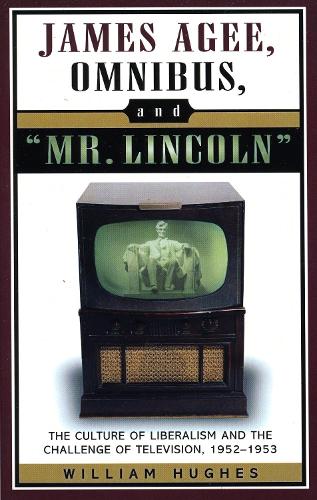
James Agee, Omnibus, and Mr. Lincoln by William Hughes
In 1952 CBS, in conjunction with the Ford Foundation, launched Omnibus, a remarkable experiment in television. The objective was to raise the programming standards of an emerging medium that figured to profoundly influence American life. The centerpiece of Omnibus during its inaugural season was Mr. Lincoln, a series of five films about the early life of our foremost political icon. James Agee, the distinguished American author, was the principal creator of Mr. Lincoln. At the time, his scripts were hailed as 'the most beautiful writing ever done for television, and even today Agee's characterization of Lincoln remains among the finest-perhaps the finest-film about Abraham Lincoln ever made. Regrettably, this important and sensitive work, a revealing expression of American culture at mid-century, has been consigned to the archives and has not been available to the public for many years. Author William Hughes aims to keep alive Agee's neglected masterpiece, placing Mr. Lincoln in the context of the period's prevailing ideology (Cold War liberalism) and conveying the institutional framework in which the work originated. In addition, Hughes takes into account Agee's personal experiences, his social and political views, and his related writings (for and about film), all of which came into play when he reworked the Lincoln legend for the television age. Based on extensive archive research and an interview with Norman Lloyd, who directed the five films, this book fully documents the cultural and historical importance of Mr. Lincoln.
An interesting and historical account of early US television, this volume brings back one of the era's excellent programs and one of the finest treatments of Lincoln ever aired - a television experience lost to present-day audiences...Highly recommended. Lower-division undergraduates through faculty and professionals; general readers. * CHOICE *
When Agee agreed to write a five-part script for the infant television industry's series Omnibus, he had to work within his own and his society's ideological and institutional conflicts. His product had to satisfy the crude orthodoxy of McCarthyism and meet the expectations of his patrons to attract and inspire the middlebrow middle-class. How Agee interpreted the image rather than the fact of Lincoln for a Cold War audience (which was also dealing with the shadow and substance of the Civil War) is a study in how artists can honor their own integrity under conditions of accommodation. * Reference and Research Book News *
Hughes has written an indispensable cultural study. He situates Omnibus and Agee himself in the context of political and corporate ideologies of the 1950s. . . . [A] fine historical and critical analysis of 'Mr. Lincoln.' -- Jeffrey Couchman, author of Night of the Hunter: A Biography of a Film
A thorough and truly excellent account of Omnibus' place in the Ford Foundation's cultural Cold War. -- Anna McCarthy, associate professor of cinema studies at NYU; author of The Citizen Machine: Governing By Television in 1950s America
When Agee agreed to write a five-part script for the infant television industry's series Omnibus, he had to work within his own and his society's ideological and institutional conflicts. His product had to satisfy the crude orthodoxy of McCarthyism and meet the expectations of his patrons to attract and inspire the middlebrow middle-class. How Agee interpreted the image rather than the fact of Lincoln for a Cold War audience (which was also dealing with the shadow and substance of the Civil War) is a study in how artists can honor their own integrity under conditions of accommodation. * Reference and Research Book News *
Hughes has written an indispensable cultural study. He situates Omnibus and Agee himself in the context of political and corporate ideologies of the 1950s. . . . [A] fine historical and critical analysis of 'Mr. Lincoln.' -- Jeffrey Couchman, author of Night of the Hunter: A Biography of a Film
A thorough and truly excellent account of Omnibus' place in the Ford Foundation's cultural Cold War. -- Anna McCarthy, associate professor of cinema studies at NYU; author of The Citizen Machine: Governing By Television in 1950s America
William Hughes taught for many years at the Community College of Baltimore County and has written extensively about film and the history of American culture. He is an associate editor of American National Biography.
| SKU | Unavailable |
| ISBN 13 | 9780810851757 |
| ISBN 10 | 081085175X |
| Title | James Agee, Omnibus, and Mr. Lincoln |
| Author | William Hughes |
| Series | Studies And Documentation In The History Of Popular Entertainment |
| Condition | Unavailable |
| Binding Type | Paperback |
| Publisher | Scarecrow Press |
| Year published | 2004-08-02 |
| Number of pages | 188 |
| Cover note | Book picture is for illustrative purposes only, actual binding, cover or edition may vary. |
| Note | Unavailable |