


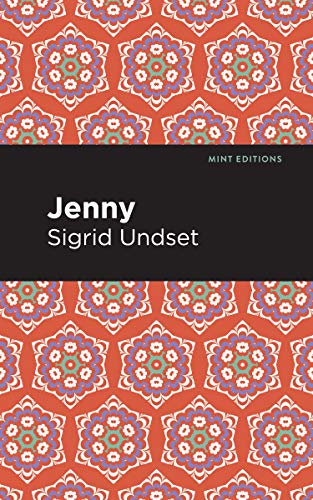
Jenny by Sigrid Undset
Jenny (1911) is a novel by Norwegian writer Sigrid Undset. Published during the author's social realist phase, a period in which her writing focused on the lives of everyday Norwegians, Jenny is a moving portrait of idealism and ambition and a tragic tale of talent gone to seed. Although Undset's later fiction--inspired by her conversion to Catholicism--won her the 1928 Nobel Prize in Literature, her earlier work has remained essential to her legacy.
Finding herself uninspired in her native Norway, Jenny Winge, an idealistic and talented painter, moves to Rome in order to further her artistic career. There, she finds not only success, but a fiancé with whom she envisions sharing a life and family. Moved by hidden desires, however, Jenny strikes up an affair with the man's father that leaves her pregnant, disgraced, and alone. Determined as ever despite being shaken from her path as an artist, Jenny determines to raise the child by herself, forsaking convention while simultaneously risking her life and the life of her baby. From artistic achievement to mere independence, Jenny is forced to drastically shift her ambitions, to remain unbroken in a world that seems intent on breaking every hope she holds. Jenny is a realist novel that takes an unsparing look at the role of women in society while illuminating the struggles a young artist faces on the path to success and independence.
This edition of Sigrid Undset's Jenny is a classic of Norwegian literature reimagined for modern readers.
Since our inception in 2020, Mint Editions has kept sustainability and innovation at the forefront of our mission. Each and every Mint Edition title gets a fresh, professionally typeset manuscript and a dazzling new cover, all while maintaining the integrity of the original book.
With thousands of titles in our collection, we aim to spotlight diverse public domain works to help them find modern audiences. Mint Editions celebrates a breadth of literary works, curated from both canonical and overlooked classics from writers around the globe.
-
 Carmilla
-
 The Life of Samuel Johnson
-
 Siddhartha
-
 My Man Jeeves
-
 The Vampyre
-
 Reynolds Pamphlet
-
 The Waste Land
-
 Bartleby, The Scrivener
-
 Venus in Furs
-
 The House on the Borderland
-
 The Iron Heel
-
 Rajmohan's Wife and Sultana's Dream
-
 The Discovery of Witches
-
 The Great God Pan
-
 We
We
-
 The Romance of a Shop
-
 Whose Body?
-
 The Sins of the Cities of the Plain
-
 Harlem Shadows
-
 The Man Who Laughs
-
 The Castles of Athlin and Dunbayne
-
 The Sorrows of Satan
-
 The King of Elfland's Daughter
-
 The Poems of Phillis Wheatley
-
 The King in Yellow
-
 Spring and All
-
 Living Alone
-
 Phantastes
-
 Stray Birds
-
 The Road
-
 Paradise Regained
-
 The Convent of Pleasure
-
 Aeropagitica
-
 The Marriage of Heaven and Hell
-
 The Flowers of Evil
-
 Love in Excess
-
 Black No More
-
 The Flying Inn
-
 Fantomina
-
 A London Plane-Tree and Other Verse
-
 North of Boston
-
 As A Man Thinketh
-
 Twenty
-
 The Haunted Bookshop
-
 A Boy's Will
-
 The Red Record


Sigrid Undset (1882-1949), the eldest daughter of a Norwegian father and a Danish mother, was born in Denmark. Her family relocated to Oslo two years after her birth, where her father, a renowned archaeologist, lectured at the university. Undset was greatly influenced by her father's interest in the past. She was particularly enthralled by the dramatic Old Norse sagas she read as a kid, later remarking that her first encounter with them was the most significant turning point in my life. Mrs. Undset was Undset's first published piece.
Marta Oulie (1907) and The Good Era (1908), a collection of short stories set in modern circumstances, were critical and popular successes. Undset had the opportunity to explore the culture that had initially piqued her interest as a writer, and in Gunnar's Daughter (1909), she drew on her knowledge of Norwegian history and mythology, especially the Icelandic Sagas, to reconstruct medieval life with captivating immediacy. Undset married the painter Anders Castus Svarstad in 1912 and faced the difficult task of parenting three stepchildren and her own three children with no financial or emotional support from her husband over the next ten years. Her marriage was ended in 1924 after Undset converted to Catholicism, and she and her children eventually moved from Oslo to Lillehammer.
Undset's passion with the Middle Ages never waned, and she released The Wreath, the first volume of her most renowned work, Kristin Lavransdatter, in 1920, despite writing more modern novels, a collection of feminism essays, as well as numerous book reviews and newspaper articles. The Wife was published in 1921, while The Cross was published in 1922. Undset's first great medieval epic, the four-volume The Master of Hestviken (1925-1927), garnered her international renown, and her second great medieval epic, The Master of Hestviken (1925-1927), cemented her reputation as one of the twentieth century's best writers. She was only the third woman to receive the Nobel Prize in Literature, at the age of 46, in 1928.
During the 1930s, Undset published numerous books, notably the autobiographical The Longest Years, as well as various collections of essays. Undset, an outspoken Nazi critic, fled Norway in 1940 as the Germans moved through the country, eventually settling in Brooklyn, New York. She returned to Norway in 1945 and received Norway's highest medal two years later for her exceptional literary achievement and dedication to the country. But, her years of exile had taken their toll, and she died of a stroke on June 10, 1949.
| SKU | Unavailable |
| ISBN 13 | 9781513271934 |
| ISBN 10 | 1513271938 |
| Title | Jenny |
| Author | Sigrid Undset |
| Series | Mint Editions |
| Condition | Unavailable |
| Binding Type | Paperback |
| Publisher | Mint Editions |
| Year published | 2021-04-08 |
| Number of pages | 250 |
| Cover note | Book picture is for illustrative purposes only, actual binding, cover or edition may vary. |
| Note | Unavailable |