


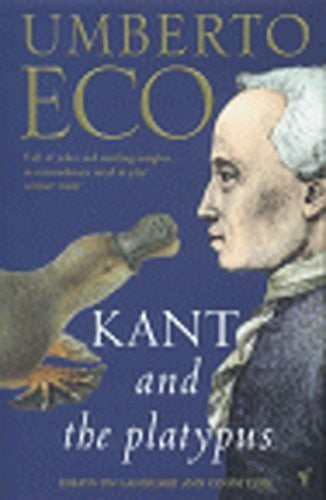
Kant And The Platypus by Umberto Eco
How much do our perceptions of things depend on our cognitive ability, and how much on our linguistic resources? Where, and how, do these two questions meet? Umberto Eco undertakes a series of idiosyncratic and typically brilliant explorations, starting from the perceived data of common sense, from which flow an abundance of 'stories' or fables, often with animals as protagonists, to expound a clear critique of Kant, Heidegger and Peirce. And as a beast designed specifically to throw spanners in the works of cognitive theory, the duckbilled platypus naturally takes centre stage.
Full of jokes, conundra and startling insights..Eco has both moved with the times and moved his discipline along... Few will come to Kant and the Platypus for a bulletin on the world of literary theory...what the general reader will find here is an extraordinary mind at play * Sunday Times *
A typical Eco book in its scope and vastness of ambition. In his hands, semiotics is transformed from a specialist branch of learning into a theory of everything...readers will not fail to be stimulated * Daily Telegraph *
Eco's sensitivity to the mysteries of signification supplies the irony and perceptiveness of his essays. Here, he addresses the mysteries themselves. He does it in characteristic fashion, with wit and invention; but with serious intent too... Eco deploys all his skills of anecdote and illustration, pleasurably decorating an earnest and complicated matter * Financial Times *
Umberto Eco is perhaps the leading contemporary representative of the philosophy of semiotics... The discussion is consistently fertile and provocative and provides a wealth of suggestive anecdotes and illustrations * Spectator *
A typical Eco book in its scope and vastness of ambition. In his hands, semiotics is transformed from a specialist branch of learning into a theory of everything...readers will not fail to be stimulated * Daily Telegraph *
Eco's sensitivity to the mysteries of signification supplies the irony and perceptiveness of his essays. Here, he addresses the mysteries themselves. He does it in characteristic fashion, with wit and invention; but with serious intent too... Eco deploys all his skills of anecdote and illustration, pleasurably decorating an earnest and complicated matter * Financial Times *
Umberto Eco is perhaps the leading contemporary representative of the philosophy of semiotics... The discussion is consistently fertile and provocative and provides a wealth of suggestive anecdotes and illustrations * Spectator *
Umberto Eco (1932–2016) wrote fiction, literary criticism and philosophy. His first novel, The Name of the Rose, was a major international bestseller. His other works include Foucault's Pendulum, The Island of the Day Before, Baudolino, The Mysterious Flame of Queen Loana, The Prague Cemetery and Numero Zero along with many brilliant collections of essays.
| SKU | Unavailable |
| ISBN 13 | 9780099276951 |
| ISBN 10 | 009927695X |
| Title | Kant And The Platypus |
| Author | Umberto Eco |
| Condition | Unavailable |
| Binding Type | Paperback |
| Publisher | Vintage Publishing |
| Year published | 2000-09-07 |
| Number of pages | 480 |
| Cover note | Book picture is for illustrative purposes only, actual binding, cover or edition may vary. |
| Note | Unavailable |