
Kierkegaard and the Quest for Unambiguous Life


Summary
The feel-good place to buy books
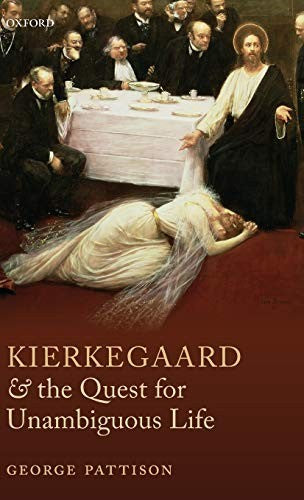
Kierkegaard and the Quest for Unambiguous Life by George Pattison
This book looks at Kierkegaard with a fresh perspective shaped by the history of ideas, framed by the terms romanticism and modernism. 'Modernism' here refers to the kind of intellectual and literary modernism associated with Georg Brandes, and such later nineteenth and early twentieth century figures as J. P. Jacobsen, Nietzsche, Dostoevsky, Ibsen (all often associated with Kierkegaard in early secondary literature), and the young Georg Lukacs. This movement, currently attracting increasing scholarly attention, fed into such varied currents of twentieth century thought as Bolshevism (as in Lukacs himself), fascism, and the early existentialism of, e.g., Shestov and the radical culture journal The Brenner (in which Kierkegaard featured regularly, and whose readers included Martin Heidegger). Each of these movements has, arguably, its own 'Romantic' aspect and Kierkegaard thus emerges as a figure who holds together or in whom are reflected both the aspirations and contradictions of early romanticism and its later nineteenth and twentieth century inheritors. Kierkegaard's specific 'staging' of his authorship in the contemporary life of Copenhagen, then undergoing a rapid transformation from being the backward capital of an absolutist monarchy to a modern, cosmopolitan city, provides a further focus for the volume. In this situation the early Romantic experience of nature as providing a source of healing and an experience of unambiguous life is transposed into a more complex and, ultimately, catastrophic register. In articulating these tensions, Kierkegaard's authorship provided a mirror to his age but also anticipated and influenced later generations who wrestled with their own versions of this situation.
[a] rich cycle of essays.. lucid and illuminating * Daniel Watts, Times Literary Supplement *
George Pattison is Lady Margaret Professor of Divinity at the University of Oxford and a Canon of Christ Church Cathedral. He has taught at the University of Aarhus and is a vising professor at the University of Copenhagen. For ten years he was Dean of Chapel at King's College, Cambridge and before that was a parish priest for 14 years. He studied at Edinburgh and Durham. He has written extensively on modern theology and philosophy of religion, with special emphasis on Kierkegaard and existentialism, including Heidegger and Dostoevsky, as well as on theology and the arts.
| SKU | Unavailable |
| ISBN 13 | 9780199698677 |
| ISBN 10 | 0199698678 |
| Title | Kierkegaard and the Quest for Unambiguous Life |
| Author | George Pattison |
| Condition | Unavailable |
| Binding Type | Hardback |
| Publisher | Oxford University Press |
| Year published | 2013-01-10 |
| Number of pages | 264 |
| Cover note | Book picture is for illustrative purposes only, actual binding, cover or edition may vary. |
| Note | Unavailable |