


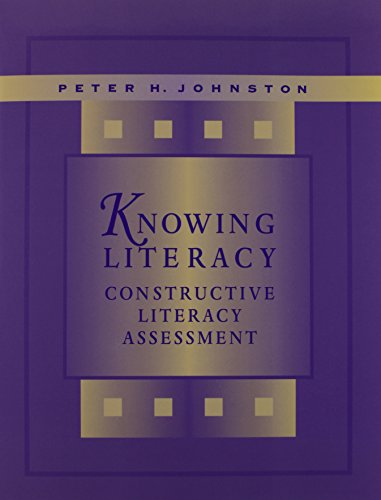
Knowing Literacy by Peter Johnston
American children are the most tested in the world, and the poor and the less competent are the most tested of all. We keep trying to improve literacy learning by developing new tests with better technical characteristics. But, as we shall see, all of this testing has had, if anything, the opposite effect. Our error has been in approaching the matter as if it were merely a technical problem--as if it were possible, even desirable, to exclude human judgment and values from the assessment process, and as if it were reasonable to treat children as psychological objects. Assessment is a profoundly human, social phenomenon, thoroughly value-laden, and it cannot be otherwise. And in order to draw valid conclusions about a child's learning, a teacher must understand how learning takes place. The very complexity of this is in knowing the available assessment options and understanding their consequences. In Knowing Literacy Peter Johnston sets forth the theoretical basis for today's assessment practices in the context of contemporary literacy learning theory. This comprehensive text will equip teachers with the knowledge and techniques to assess in ways that help their students develop a more thoughtful literacy. Part One describes the social and educational basis of literacy assessment, and develops an understanding of the knowledge required for accurate assessment, including the connections between a teacher's assessment practices and students' self-assessments. Part Two explores the personal, social, and intellectual nature of literacy and its development-what characteristics to notice and document and what they mean. Part Three illustrates methods of documenting that development in ways that will contribute to the growth of a democratic literacy. These chapters offer examples of checklists, report cards, portfolios, and observation forms, and discuss their possibilities and implications. Two chapters, co-authored with Marie Clay, are accompanied by a CD of children reading. These chapters and the tape show you step-by-step how to make and interpret running records of children's oral reading. Part Four is intended to change the ways we talk about children's literacy development. It provides ways to engage various members of the school community in productive conversations about literate teaching and learning. The final chapter helps us understand how to keep track of literate development without losing our way and forgetting the point of literacy learning.Peter Johnston grew up in New Zealand and taught elementary school before moving to the United States to pursue his Ph.D. at the University of Illinois' Center for the Study of Reading His goals at the time did not include living in the United States, let alone marrying and starting a family. Peter's study and writing stem from his passion with daughters's learning and, no less, instructors' teaching. He presently resides in Albany, New York, with his wife Tina and a cat left behind by one of his (three) children returning short from college. Surprisingly, he feels that education is more than just imparting knowledge to youngsters.
He believes it is more about creating a just and caring society, and that doing so will not detract from our more evident educational objectives. Peter Stenhouse, a professor in the State University of New York at Albany, and his colleagues Becky Rogers and Cheryl Dozier just published Critical Literacy/Critical Teaching: To Teach Beginning Teachers, which uses his fascination with the relationship between language and learning to show how this works moment to moment in the classroom. Understanding Literacy, his most recent book on assessment, originated from his fascination with the connections between assessment, teaching, and learning. Because of its consequences on teaching and learning, his assessment research has led him to be wary of high-stakes testing. When asked to characterize himself as a writer, he says he binges.
While this strategy is not recommended, it has resulted in the publication of eight books and fifty research articles, as well as a few professional prizes. Of course, age plays a role in some of this. His recent election to the Reading Hall of Fame, combined with the departure of his youngest daughter into a teacher education program, confirms his old fart status. Beyond his family, research, soccer, singing, and comedy keep him going. If everything else fails, a glass of chardonnay will assist.
| SKU | Unavailable |
| ISBN 13 | 9781571100085 |
| ISBN 10 | 1571100083 |
| Title | Knowing Literacy |
| Author | Peter Johnston |
| Condition | Unavailable |
| Binding Type | Paperback |
| Publisher | Taylor & Francis Inc |
| Year published | 1997-04-01 |
| Number of pages | 368 |
| Cover note | Book picture is for illustrative purposes only, actual binding, cover or edition may vary. |
| Note | Unavailable |