
The Law Emprynted and Englysshed


World of Books
The feel-good place to buy books
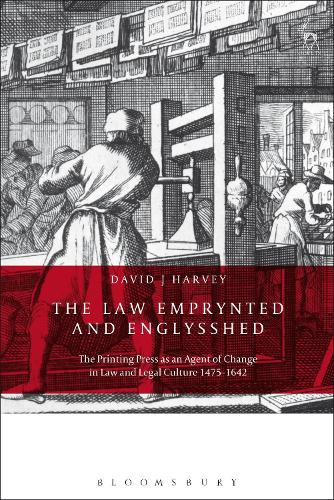
The Law Emprynted and Englysshed by David John Harvey
This book considers the impact of the printing press within the context of the intellectual activity of the English legal profession in the 16th and 17th centuries. The legal profession had developed a sophisticated educational process and practice based upon an oral/aural system, along with the utilization of manuscript materials, largely self-created. The printing press provided an alternative to this culture as printed law books - law reports, abridgements, and treatises - became increasingly available and were used by lawyers and students. At the same time, movements were afoot to discard the arcane language of the law and make printed legal materials available in English. A tension arose as the advantages of print were recognized by the authorities - the Church and the State. Those very qualities also turned out to be disadvantages as the authorities struggled to regulate the vastly increased flow of information that the printing press enabled. The legal works printed in the 16th century were primarily law reports and abridgements with a new style of law report becoming evident with the printing of Plowden's Commentaries and, in the 17th century, the works of Sir Edward Coke. Print enabled legal writers to concentrate upon principle rather than pleading and procedure. The 17th century also saw a shift from printed reports to printed treatises and guide books for administrators and members of the lower branch of the legal profession. Legal information for the purposes of standardizing procedures and for educational purposes, as a supplement to a troubled traditional legal education system, began to dominate. Subject: Legal History, Copyright Law, English Law]
This book has fascinating parallels with the legal profession's present-day adaptation from working with print to working with digital materials, and with finding new ways of practising the law-- Katherine Laundy * canadian Law Library Review *
Starting in 1475 and concluding in 1642, the book targets a fitting timeframe, and the book takes the reader on a well-described journey through the various stages of printing press regulation by the government without getting lost in a debate on censorship...The book does an excellent job of showing the way in which technological innovation in the dissemination of information changed how it affected jurists and legal thinking by way of massproduced law reports and treatises. -- Niels Pepels, Max Planck Institute for European Legal History * Journal of the Max Planck Institute for European Legal History *
Starting in 1475 and concluding in 1642, the book targets a fitting timeframe, and the book takes the reader on a well-described journey through the various stages of printing press regulation by the government without getting lost in a debate on censorship...The book does an excellent job of showing the way in which technological innovation in the dissemination of information changed how it affected jurists and legal thinking by way of massproduced law reports and treatises. -- Niels Pepels, Max Planck Institute for European Legal History * Journal of the Max Planck Institute for European Legal History *
David J Harvey is a District Court Judge sitting in Auckland, New Zealand and a part-time lecturer in Law and Information Technology at the Faculty of Law, University of Auckland.
| SKU | Unavailable |
| ISBN 13 | 9781509914159 |
| ISBN 10 | 1509914153 |
| Title | The Law Emprynted and Englysshed |
| Author | David John Harvey |
| Condition | Unavailable |
| Binding Type | Paperback |
| Publisher | Bloomsbury Publishing PLC |
| Year published | 2017-05-25 |
| Number of pages | 326 |
| Cover note | Book picture is for illustrative purposes only, actual binding, cover or edition may vary. |
| Note | Unavailable |