


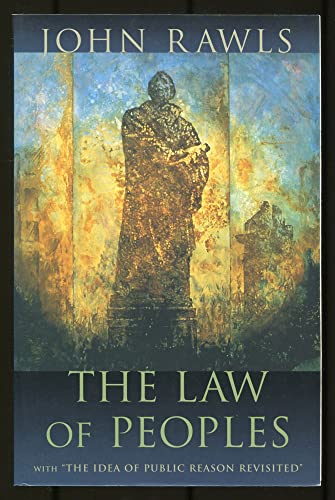
The Law of Peoples by John Rawls
The Law of Peoples extends the idea of a social contract to the Society of Peoples and lays out the principles that should be accepted as the standard for regulating a society's behavior toward another. In particular, it draws a distinction between basic human rights and the rights of each citizen of a liberal constitutional democracy.
[These essays are] some of [Rawls’s] strongest published expressions of feeling… These are the final products of a remarkably pure and concentrated career… The writings of John Rawls, whom it is now safe to describe as the most important political philosopher of the twentieth century…owe their influence to the fact that their depth and their insight repay the close attention that their uncompromising theoretical weight and erudition demand-- Thomas Nagel * New Republic *
Rawls offers us the appealing vision of a social order that every citizen finds legitimate despite large differences in their personal values. In The Law of Peoples, he attempts a parallel feat for global society. He tries to spell out a Law of Peoples that both liberal and non-liberal peoples can agree upon to govern their international relations. This involves steering a judicious mid-course between liberalism’s imperialist and isolationist tendencies… I should say straight away that this is the most engaging and accessible book Rawls has written. Although some of the daunting conceptual apparatus from Political Liberalism appears from time to time, for the most part Rawls lays out his argument in a straightforward way, and refers extensively to historical and contemporary episodes to illustrate it. -- David Miller * Times Literary Supplement *
John Rawls is one of the great political philosophers of the 20th century… His ideas have not only sparked a lively debate among philosophers, which continues to this day, but they have also been taken up by economists, sociologists and others. So The Law of Peoples, Mr. Rawls’s latest work and probably his last significant effort, deserves to be read with interest, and some respect. * The Economist *
Now, in an effort to turn realpolitik on its big, bald head, Rawls in The Law of Peoples proposes to extend his historicist, pragmatic notions of justice to the larger world of ‘peoples’—the term he prefers to ‘nations.’ He lays out a series of general principles—among them, that peoples are free and independent, should honor human rights, and should observe a duty of nonintervention—that can and should be accepted as a standard for regulating their behavior toward one another. Without the slightest hint of millenarian fever, he goes so far as to assert that we stand on the brink of a ‘realistic utopia’… The Law of Peoples seems likely to reframe the debate about what is possible in the international realm. In contrast to the chastened, inward gaze of most 20th-century thought, Rawls’s book is one of those rare works of philosophy that directs its energies outward. It has the potential to send shockingly optimistic reverberations through the world at large, and maybe even jolt those somber-suited realists right out of the realpolitik. -- Will Blythe * Civilization *
Why should we care whether Rawls has modified his difference principle so that it avoids unpopular outcomes? In the course of doing so, he advances some excellent arguments. * The Mises Review *
Rawls offers us the appealing vision of a social order that every citizen finds legitimate despite large differences in their personal values. In The Law of Peoples, he attempts a parallel feat for global society. He tries to spell out a Law of Peoples that both liberal and non-liberal peoples can agree upon to govern their international relations. This involves steering a judicious mid-course between liberalism’s imperialist and isolationist tendencies… I should say straight away that this is the most engaging and accessible book Rawls has written. Although some of the daunting conceptual apparatus from Political Liberalism appears from time to time, for the most part Rawls lays out his argument in a straightforward way, and refers extensively to historical and contemporary episodes to illustrate it. -- David Miller * Times Literary Supplement *
John Rawls is one of the great political philosophers of the 20th century… His ideas have not only sparked a lively debate among philosophers, which continues to this day, but they have also been taken up by economists, sociologists and others. So The Law of Peoples, Mr. Rawls’s latest work and probably his last significant effort, deserves to be read with interest, and some respect. * The Economist *
Now, in an effort to turn realpolitik on its big, bald head, Rawls in The Law of Peoples proposes to extend his historicist, pragmatic notions of justice to the larger world of ‘peoples’—the term he prefers to ‘nations.’ He lays out a series of general principles—among them, that peoples are free and independent, should honor human rights, and should observe a duty of nonintervention—that can and should be accepted as a standard for regulating their behavior toward one another. Without the slightest hint of millenarian fever, he goes so far as to assert that we stand on the brink of a ‘realistic utopia’… The Law of Peoples seems likely to reframe the debate about what is possible in the international realm. In contrast to the chastened, inward gaze of most 20th-century thought, Rawls’s book is one of those rare works of philosophy that directs its energies outward. It has the potential to send shockingly optimistic reverberations through the world at large, and maybe even jolt those somber-suited realists right out of the realpolitik. -- Will Blythe * Civilization *
Why should we care whether Rawls has modified his difference principle so that it avoids unpopular outcomes? In the course of doing so, he advances some excellent arguments. * The Mises Review *
John Rawls was James Bryant Conant University Professor at Harvard University. He was recipient of the 1999 National Humanities Medal.
| SKU | Unavailable |
| ISBN 13 | 9780674005426 |
| ISBN 10 | 0674005422 |
| Title | The Law of Peoples |
| Author | John Rawls |
| Condition | Unavailable |
| Binding Type | Paperback |
| Publisher | Harvard University Press |
| Year published | 2001-03-02 |
| Number of pages | 208 |
| Prizes | Nominated for David and Elaine Spitz Prize 2001, Nominated for Rachel Carson Prize & Ludwik Fleck Prize 2002 |
| Cover note | Book picture is for illustrative purposes only, actual binding, cover or edition may vary. |
| Note | Unavailable |