
Letters on the Elements of Botany


Summary
The feel-good place to buy books
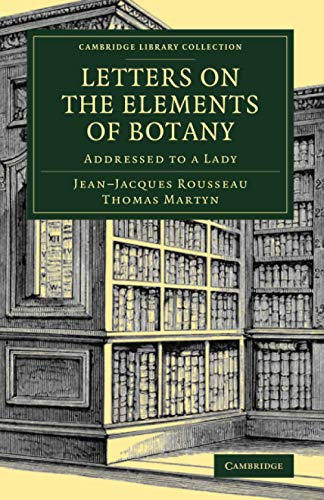
Letters on the Elements of Botany by Jean-Jacques Rousseau
Among the many interests of Swiss philosopher Jean-Jacques Rousseau (1712–78) was botany. These letters 'addressed to a lady' came to the attention of Thomas Martyn, professor of botany at the University of Cambridge, who thought that 'if [they were] translated into English, they might be of use to such … as wished to amuse themselves with natural history'. However, when the translation was done, he 'perceived that the foundation only being laid by the ingenious author, it could be of little service, without raising the superstructure'. Martyn's 1785 publication, of which we have reissued the 1791 third edition, adds notes and corrections to Rousseau's original thirty-two letters which explain the structure of plants and their ordering in the Linnaean system. Martyn urges the reader not to study it 'in the easy chair at home': it 'can be no use but to such as have a plant in their hand'.
JEAN-JACQUES ROUSSEAU was born in Geneva on June 28, 1712, and raised by his father after his mother died giving him life. The reproachment Rousseau experienced at his father's hand produced feelings of guilt and inferiority that were to haunt him throughout his life. During his youth, Rousseau wandered throughout Europe from job to job. Having moved to Paris from the city of Lyon in 1742, Rousseau sought the intellectual life and soon became associated with Denis Diderot and the philosophes.
Rousseau's literary career began with his entry in an essay contest in 1749 on the subject of the relationship of science and the arts to morals. His winning essay, Discourses on Sciences and the Arts, soon became the foundation for his later work entitled the Discourse on the Origin of Inequality (1753). With its publication, he became a figure of some controversy in France. Ideological differences between his views and those of his Enlightenment contemporaries soon surfaced, and Rousseau once again found himself alienated from the intellectual establishment. His differences with the philosophes proved to be the impetus for Rousseau's future work on the content of human nature and man's rela-tionship to society and the state. Contrary to the individualism and intel-lectual enlightenment advocated by his contemporaries, Rousseau sought to sublimate individuality in the security of the collective per-sonality known as the general will. This new society would be typified by concern for the community and would be ruled by laws developed through a plan of controlled participation. Rousseau's social theory was developed in his work Julie, ou la Nouvelle Heloise (1761) and in Emile (1762). The institutional structure was constructed in The Social Con-tract (1761). In Emile, Rousseau presents his utopian vision of child-centered education, full of the sentiments of Romanticism, a movement that Rousseau inspired. Rousseau's later years were spent fighting off persecution, both real and imaginary. He died near Paris on July 2, 1778.
Rousseau's literary career began with his entry in an essay contest in 1749 on the subject of the relationship of science and the arts to morals. His winning essay, Discourses on Sciences and the Arts, soon became the foundation for his later work entitled the Discourse on the Origin of Inequality (1753). With its publication, he became a figure of some controversy in France. Ideological differences between his views and those of his Enlightenment contemporaries soon surfaced, and Rousseau once again found himself alienated from the intellectual establishment. His differences with the philosophes proved to be the impetus for Rousseau's future work on the content of human nature and man's rela-tionship to society and the state. Contrary to the individualism and intel-lectual enlightenment advocated by his contemporaries, Rousseau sought to sublimate individuality in the security of the collective per-sonality known as the general will. This new society would be typified by concern for the community and would be ruled by laws developed through a plan of controlled participation. Rousseau's social theory was developed in his work Julie, ou la Nouvelle Heloise (1761) and in Emile (1762). The institutional structure was constructed in The Social Con-tract (1761). In Emile, Rousseau presents his utopian vision of child-centered education, full of the sentiments of Romanticism, a movement that Rousseau inspired. Rousseau's later years were spent fighting off persecution, both real and imaginary. He died near Paris on July 2, 1778.
| SKU | Unavailable |
| ISBN 13 | 9781108076722 |
| ISBN 10 | 1108076726 |
| Title | Letters on the Elements of Botany |
| Author | Jean Jacques Rousseau |
| Series | Cambridge Library Collection - Botany And Horticulture |
| Condition | Unavailable |
| Binding Type | Paperback |
| Publisher | Cambridge University Press |
| Year published | 2017-07-27 |
| Number of pages | 562 |
| Cover note | Book picture is for illustrative purposes only, actual binding, cover or edition may vary. |
| Note | Unavailable |