


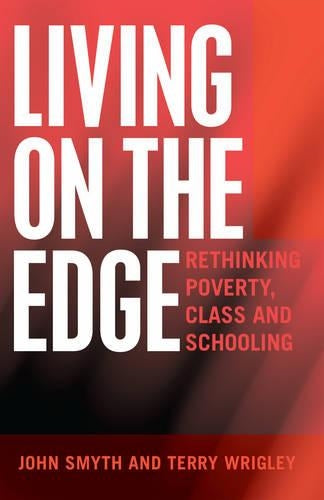
Living on the Edge by John Smyth
This book confronts one of the most enduring and controversial issues in education the nexus between poverty and underachievement. The authors draw upon positive examples of schools which are succeeding in engaging marginalized young people, providing worthwhile forms of learning, and improving young lives.
?Living on the Edge' tackles tough issues about class, poverty and justice that are of central importance for teachers, parents, policy-makers - and young peopleThe book combines clear writing, good scholarship, and firm commitment. Clearing a path through the forest of misleading ideas about educational disadvantage, Smyth and Wrigley show the educational damage done by current market-driven policies and testing systems. Bringing together the experience of creative teachers and schools that work well in tough circumstances, they show how schools can make positive and immediate gains for fairness and good education. (Raewyn Connell, University Chair, Faculty of Education and Social Work, University of Sydney)
This book addresses what is now the central but unaddressed issue in education policy in developed societies - the abhorrent, debilitating and humiliating relationship between poverty and schooling. Smyth and Wrigley rigorously and painfully lay out this relationship and all its aspects and shame us all - policymakers most of all! This is a book that cannot, must not be ignored. (Stephen Ball, Karl Mannheim Professor of Sociology of Education, Institute of Education, University of London)
?Living on the Edge' tackles tough issues about class, poverty and justice that are of central importance for teachers, parents, policy-makers - and young people. The book combines clear writing, good scholarship, and firm commitment. Clearing a path through the forest of misleading ideas about educational disadvantage, Smyth and Wrigley show the educational damage done by current market-driven policies and testing systems. Bringing together the experience of creative teachers and schools that work well in tough circumstances, they show how schools can make positive and immediate gains for fairness and good education. (Raewyn Connell, University Chair, Faculty of Education and Social Work, University of Sydney)
This book addresses what is now the central but unaddressed issue in education policy in developed societies - the abhorrent, debilitating and humiliating relationship between poverty and schooling. Smyth and Wrigley rigorously and painfully lay out this relationship and all its aspects and shame us all - policymakers most of all! This is a book that cannot, must not be ignored. (Stephen Ball, Karl Mannheim Professor of Sociology of Education, Institute of Education, University of London)
This book addresses what is now the central but unaddressed issue in education policy in developed societies - the abhorrent, debilitating and humiliating relationship between poverty and schooling. Smyth and Wrigley rigorously and painfully lay out this relationship and all its aspects and shame us all - policymakers most of all! This is a book that cannot, must not be ignored. (Stephen Ball, Karl Mannheim Professor of Sociology of Education, Institute of Education, University of London)
?Living on the Edge' tackles tough issues about class, poverty and justice that are of central importance for teachers, parents, policy-makers - and young people. The book combines clear writing, good scholarship, and firm commitment. Clearing a path through the forest of misleading ideas about educational disadvantage, Smyth and Wrigley show the educational damage done by current market-driven policies and testing systems. Bringing together the experience of creative teachers and schools that work well in tough circumstances, they show how schools can make positive and immediate gains for fairness and good education. (Raewyn Connell, University Chair, Faculty of Education and Social Work, University of Sydney)
This book addresses what is now the central but unaddressed issue in education policy in developed societies - the abhorrent, debilitating and humiliating relationship between poverty and schooling. Smyth and Wrigley rigorously and painfully lay out this relationship and all its aspects and shame us all - policymakers most of all! This is a book that cannot, must not be ignored. (Stephen Ball, Karl Mannheim Professor of Sociology of Education, Institute of Education, University of London)
John Smyth is Research Professor of Education, University of Ballarat, Australia and Emeritus Professor, Flinders University. His most recent books include Hanging in with Kids in Tough Times (Peter Lang, 2010), Critical Pedagogy for Social Justice, and From Silent Witnesses to Active Agents: Student Voice in Re-engaging with Learning (Peter Lang, 2012).
Terry Wrigley is Visiting Professor of School Improvement, Leeds Metropolitan University, England and Senior Honorary Research Fellow, University of Ballarat. He is editor of the international journal Improving Schools. His books include The Power to Learn (2000), Schools of Hope (2003), Another School is Possible (2006), Changing Schools: Alternative Ways to Make a World of Difference (eds. 2012), and Social Justice Re-examined (eds. 2012).
Terry Wrigley is Visiting Professor of School Improvement, Leeds Metropolitan University, England and Senior Honorary Research Fellow, University of Ballarat. He is editor of the international journal Improving Schools. His books include The Power to Learn (2000), Schools of Hope (2003), Another School is Possible (2006), Changing Schools: Alternative Ways to Make a World of Difference (eds. 2012), and Social Justice Re-examined (eds. 2012).
| SKU | Unavailable |
| ISBN 13 | 9781433116858 |
| ISBN 10 | 1433116855 |
| Title | Living on the Edge |
| Author | John Smyth |
| Series | Adolescent Cultures School And Society Ser |
| Condition | Unavailable |
| Binding Type | Paperback |
| Publisher | Peter Lang Publishing Inc |
| Year published | 2013-08-22 |
| Number of pages | 239 |
| Cover note | Book picture is for illustrative purposes only, actual binding, cover or edition may vary. |
| Note | Unavailable |