


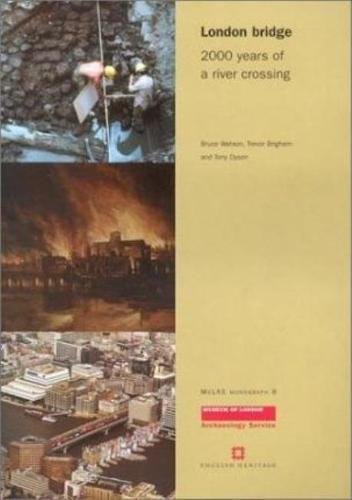
London Bridge by Bruce Watson
London developed as a port and a city because of the Thames estuary, which offers an excellent navigable routeway from the North Sea westwards far into central England. The Romans realised that it was the most convenient place to bridge the estuary, and constructed a series of bridges, which apparently went out of use during the 4th century AD. The Thames was not bridged again until c.1000 AD when the first of a series of timber bridges was erected, initially to prevent Viking raiders sailing upstream. The great stone bridge lined with houses was constructed c1176-1209. Twice in 1281-2 and 1437, parts of the stone bridge were broken by a combination of ice and neglect. It was demolished in 1831-2 after the construction of a new bridge upstream. This volume is based on the 1984 investigation of the Southwark medieval bridge abutment and combines the archaeological, architectural, historical and pictorial evidence for London's greatest bridge. The scene of battles and pageants, London Bridge was also where the 'keep left' on the road rule began in 1722.
Bruce Allen Watson is professor emeritus at Diablo Valley College and author of several books.
| SKU | Unavailable |
| ISBN 13 | 9781901992182 |
| ISBN 10 | 1901992187 |
| Title | London Bridge |
| Author | Bruce Watson |
| Series | Molas Monograph |
| Condition | Unavailable |
| Binding Type | Paperback |
| Publisher | Museum of London Archaeology |
| Year published | 2001-09-07 |
| Number of pages | 258 |
| Cover note | Book picture is for illustrative purposes only, actual binding, cover or edition may vary. |
| Note | Unavailable |