


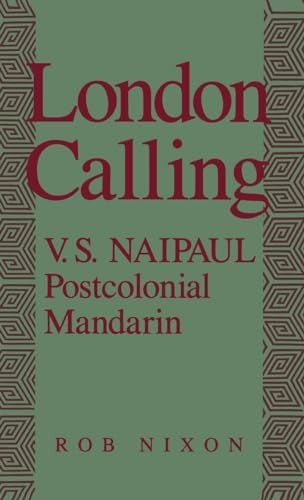
London Calling by Rob Nixon
V. S. Naipaul stands as the most lionized literary mediator between First and Third-World experience and is ordinarily viewed as possessing a unique authority on the subject of cross-cultural relations in the post-colonial era. In contesting this orthodox reading of his work, Nixon argues that Naipaul is more than simply an unduly influential writer. He has become a regressive Western institution, articulating a set of values that perpetuates political interests and representational modes that have their origin in the high imperial age. Nixon uses Naipaul's travel writing to probe the core theoretical issues raised by cross-cultural representation along metropolitan-periphery lines. In successive chapters he explores the relation between multi-cultural identity and the rhetorical conventions of exile; the imperial undertow in travel writing as a genre; the tensions between ethnographic and autobiographical modes of authority; and the magnetic pull of the Conradian tradition in figuring the third World. In the penultimate chapter, Nixon analyses the importance of the discourse of primitivism as a means of abrogating Third World experiences of historical change and, in particular, of minimalizing the role of indigenous resistance. Finally, with reference to economic theories of dependency, he critiques the vision, popularized by Naipaul, of the post-colonial world as divided between mimic and parasitic Third World nations on the one hand and, on the other, the benignly creative societies of the West.
`The strength of Nixon's critique lies partly in his awareness of the vast body of literature emanating from the former colonies - and those who have migrated from them - since the 1950s' Maya Jaggi, The Guardian
'His business is quite simply to expose what he regards as the falsity of Naipaul's position as a disinterested observer of, and expert on, the 'Third World', and the reason why he does so impressively is that he can write. His polemic is sustained and on the whole temperate. Powerfully written.' London Rview of Books
The importance of this study lies in its meticulous documentation of the ideological dimensions of Naipaul's representations of non-Western people and situations. * Modern Philology *
'His business is quite simply to expose what he regards as the falsity of Naipaul's position as a disinterested observer of, and expert on, the 'Third World', and the reason why he does so impressively is that he can write. His polemic is sustained and on the whole temperate. Powerfully written.' London Rview of Books
The importance of this study lies in its meticulous documentation of the ideological dimensions of Naipaul's representations of non-Western people and situations. * Modern Philology *
Rob Nixon is a professor at the University of Wisconsin. His work has appeared in The New Yorker, the Atlantic Monthly, the Village Voice, and Outside magazine. He has been awarded fellowships from the Guggenheim Foundation and the MacArthur Foundation, among others. Originally from South Africa, he now lives in Madison, Wisconsin.
| SKU | Unavailable |
| ISBN 13 | 9780195067170 |
| ISBN 10 | 0195067177 |
| Title | London Calling |
| Author | Rob Nixon |
| Condition | Unavailable |
| Binding Type | Hardback |
| Publisher | Oxford University Press Inc |
| Year published | 1992-05-14 |
| Number of pages | 238 |
| Cover note | Book picture is for illustrative purposes only, actual binding, cover or edition may vary. |
| Note | Unavailable |