


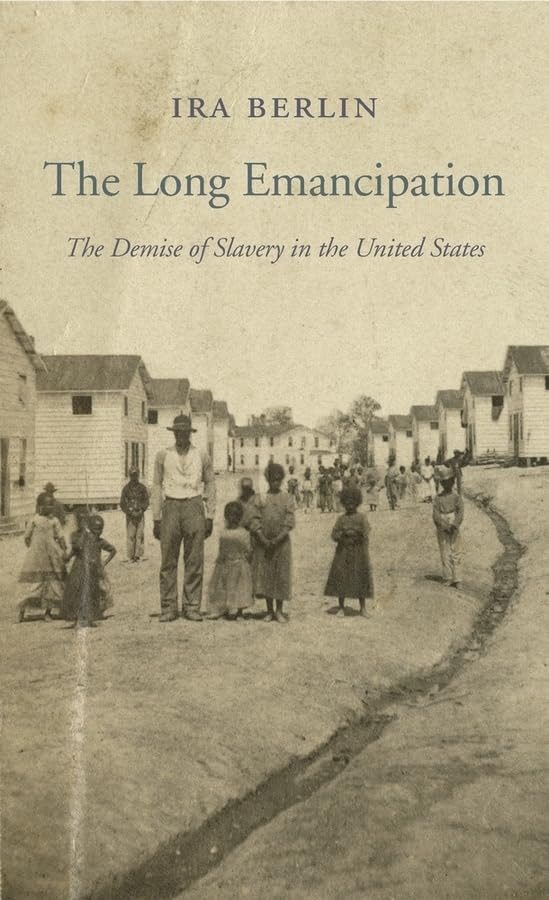
The Long Emancipation by Ira Berlin
Ira Berlin offers a framework for understanding slaverys demise in the United States. Emancipation was not an occasion but a century-long process of brutal struggle by generations of African Americans who were not naive about the price of freedom. Just as slavery was initiated and maintained by violence, undoing slavery also required violence.
Ira Berlin ranks as one of the greatest living historians of slavery in the United States… The Long Emancipation offers a useful reminder that abolition was not the charitable work of respectable white people, or not mainly thatInstead, the demise of slavery was made possible by the constant discomfort inflicted on middle-class white society by black activists. And like the participants in today’s Black Lives Matter movement, Berlin has not forgotten that the history of slavery in the United States—especially the history of how slavery ended—is never far away when contemporary Americans debate whether their nation needs to change. -- Edward E. Baptist * New York Times Book Review *
The cause of the end of slavery in the U.S. is a long, complex story that is usually, in the general reading public’s mind, simplified by ‘the Civil War ended it.’ In this remarkably cogent, impressively thought-out, and even beautifully styled account by a university historian, we are given emphatic witness to his long-held professional conviction that ‘freedom’s arrival,’ as he phrases it, was not due to a ‘moment or a man’ but because of a process that took a century to unfold. -- Brad Hooper * Booklist (starred review) *
A short, fast-paced interpretive history of the transition of African Americans from chattels to free persons. [Berlin] challenges previous scholars who identify both a ‘moment’ and a human factor that sparked emancipation—generally either President Abraham Lincoln or the South’s slaves—for initiating slavery’s overthrow. Instead, Berlin takes the long view in charting emancipation’s circuitous metamorphosis, from the late 18th century until the 1860s… In the end, Berlin credits black persons, north and south, for gradually but forcefully removing slavery’s stain from the fabric of American life. -- J. D. Smith * Choice *
Berlin lucidly illuminates the ‘near-century-long’ process of abolition and how, in many ways, the work of emancipation continues today. * Publishers Weekly *
The cause of the end of slavery in the U.S. is a long, complex story that is usually, in the general reading public’s mind, simplified by ‘the Civil War ended it.’ In this remarkably cogent, impressively thought-out, and even beautifully styled account by a university historian, we are given emphatic witness to his long-held professional conviction that ‘freedom’s arrival,’ as he phrases it, was not due to a ‘moment or a man’ but because of a process that took a century to unfold. -- Brad Hooper * Booklist (starred review) *
A short, fast-paced interpretive history of the transition of African Americans from chattels to free persons. [Berlin] challenges previous scholars who identify both a ‘moment’ and a human factor that sparked emancipation—generally either President Abraham Lincoln or the South’s slaves—for initiating slavery’s overthrow. Instead, Berlin takes the long view in charting emancipation’s circuitous metamorphosis, from the late 18th century until the 1860s… In the end, Berlin credits black persons, north and south, for gradually but forcefully removing slavery’s stain from the fabric of American life. -- J. D. Smith * Choice *
Berlin lucidly illuminates the ‘near-century-long’ process of abolition and how, in many ways, the work of emancipation continues today. * Publishers Weekly *
Ira Berlin was Distinguished University Professor at the University of Maryland, College Park.
| SKU | Unavailable |
| ISBN 13 | 9780674286085 |
| ISBN 10 | 0674286081 |
| Title | The Long Emancipation |
| Author | Ira Berlin |
| Series | The Nathan I Huggins Lectures |
| Condition | Unavailable |
| Binding Type | Hardback |
| Publisher | Harvard University Press |
| Year published | 2015-09-15 |
| Number of pages | 240 |
| Prizes | Nominated for Lincoln Prize 2016, Nominated for OAH Liberty Legacy Foundation Award 2016, Nominated for Avery O. Craven Award 2016, Nominated for James A. Rawley Prize 2016, Nominated for Anisfield-Wolf Book Awards 2016, Nominated for Frederick Douglass Book Prize 2016 |
| Cover note | Book picture is for illustrative purposes only, actual binding, cover or edition may vary. |
| Note | Unavailable |