
Lucretius and the Language of Nature


Summary
The feel-good place to buy books
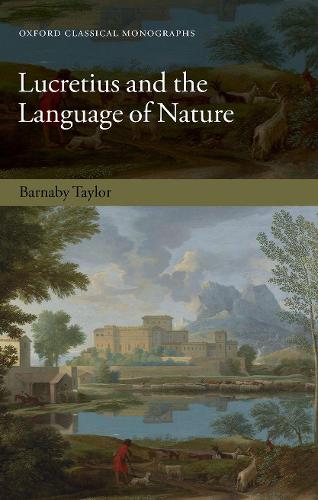
Lucretius and the Language of Nature by Barnaby Taylor
Lucretius' Epicurean poem De Rerum Natura ('On the Nature of Things'), written in the middle of the first century BC, made a fundamental and lasting contribution to the language of Latin philosophy. The style of De Rerum Natura is like nothing else in extant Latin: at once archaic and modern, Romanizing and Hellenizing, intimate and sublime, it draws on multiple literary genres and linguistic registers. This book offers a study of Lucretius' linguistic innovation and creativity. Lucretius is depicted as a linguistic trailblazer, extending and augmenting the technical language of Latin in order to describe the Epicurean universe of atoms and void in all its complexity and sublimity. A detailed understanding of the Epicurean linguistic theory brings with it a greater appreciation of Lucretius' own language. Accordingly, this book features an in-depth reconstruction of certain core features of Epicurean linguistic theory. Elements of Lucretius' style discussed include his attitudes to, and use of, figurative language (especially metaphor); his explorations, both explicit and implicit, of Latin etymology; his uses of Greek; and his creative deployment of compounds and prefixed words. His practice is related throughout not only to the underlying Epicurean theory but also to contemporary Roman attitudes to style and language. The result is a new reading of one of the greatest and most difficult works to survive from the Roman world.
RecommendedResearchers and faculty. * J. S. Louzonis, CHOICE *
This monograph offers a nuanced and fresh reading of Lucretius' creative use of language with a special focus on Epicurean linguistic theory... I found it to be a refreshing deep dive into linguistic issues that are often passed over, scorned, or misunderstood in De Rerum Natura. * Christopher Trinacty, Oberlin College *
The study concludes that the Lucretian inheritance of later Latin philosophical writing is not limited to certain forms or a certain style, but extends to an ethos of creative imitation and appropriation. * New Testament Abstracts *
This monograph offers a nuanced and fresh reading of Lucretius' creative use of language with a special focus on Epicurean linguistic theory... I found it to be a refreshing deep dive into linguistic issues that are often passed over, scorned, or misunderstood in De Rerum Natura. * Christopher Trinacty, Oberlin College *
The study concludes that the Lucretian inheritance of later Latin philosophical writing is not limited to certain forms or a certain style, but extends to an ethos of creative imitation and appropriation. * New Testament Abstracts *
Barnaby Taylor is Fellow and Tutor in Classics at Exeter College, University of Oxford.
| SKU | Unavailable |
| ISBN 13 | 9780198754909 |
| ISBN 10 | 0198754906 |
| Title | Lucretius and the Language of Nature |
| Author | Barnaby Taylor |
| Series | Oxford Classical Monographs |
| Condition | Unavailable |
| Publisher | Oxford University Press |
| Year published | 2020-06-05 |
| Number of pages | 236 |
| Cover note | Book picture is for illustrative purposes only, actual binding, cover or edition may vary. |
| Note | Unavailable |