
Magnetic Resonance in Chemistry and Medicine


Summary
The feel-good place to buy books
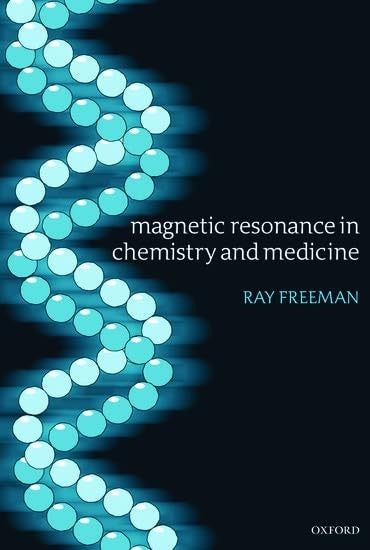
Magnetic Resonance in Chemistry and Medicine by Freeman
Magnetic resonance (MR) measures the tiny radio frequency signals emitted by the nucleus of the atom when living or inanimate material is placed in a magnetic field. On the one hand, these signals allow scientists to picture the architecture of molecules too small to be seen under the most powerful microscope, while on the other hand they give medical doctors a detailed picture of the internal structure of the human body without resorting to surgery of any kind. These two applications (high-resolution NMR spectroscopy and the MRI scanner) seem to be worlds apart, but the underlying physical principles are the same, and it makes sense to treat them together. Chemists and clinicians who use magnetic resonance have much to learn about each other's specialities if they are to make the best use of magnetic resonance technology. Many in the medical fraternity will benefit from a general appreciation of how high-resolution NMR has advanced our understanding of human biochemistry, diagnostic medicine, and the search for new drugs. A broad general understanding of magnetic resonance should prove of interest to doctors who make use of the MRI scanner, and to those of their patients who wish to learn more about these daunting machines, even if it is only the question of their own personal safety. At the other end of the spectrum, chemists and biochemists who use high-resolution NMR spectroscopy in their everyday investigations will benefit by broadening their horizons to cover the exciting new developments in MR imaging and in vivo spectroscopy, as one justification for their research is the eventual benefit to health care. Finally, anyone interested in how the human mind works (cognitive neuroscience) will find a chapter devoted to the exciting new developments in functional magnetic resonance imaging of the brain. Each disparate group has something useful to learn from the others. The treatment is pictorial rather than mathematical.
Who will profit from reading this book?.. students as well as scientists and physicians longing for a quite profound insight, not only into the basic concepts, but also the modern applications of nuclear magnetic resonance ... the book will provide valuable suggestions to everyone involved in teaching NMR to chemists and physicians. * Angewandte Chemie International Edition *
As the exposure of the wider scientific community (and the general public) to these techniques continues to increase, this book should be welcomed as a valuable way of making the basic physics behind them understandable to as wide an audience as possible. * Chemistry & Industry *
Particularly welcome is an accessible yet authoritative discussion of the possible physiological effects of uniform magnetic fields, radio frequency radiation and magnetic field gradients. * Chemistry & Industry *
The text is clear and well written, at a level accessible to anyone with a degree level background in physical science. No prior knowledge of any branch of magnetic resonance is assumed, and the amount of mathematics is kept to an absolute minimum ... This should not, however, be regarded just as a book for complete novices. It is instructive for anyone with knowledge of one area of magnetic resonance to see the parallels and differences between the two areas clearly explained by Professor Freeman. * Chemistry & Industry *
As the exposure of the wider scientific community (and the general public) to these techniques continues to increase, this book should be welcomed as a valuable way of making the basic physics behind them understandable to as wide an audience as possible. * Chemistry & Industry *
Particularly welcome is an accessible yet authoritative discussion of the possible physiological effects of uniform magnetic fields, radio frequency radiation and magnetic field gradients. * Chemistry & Industry *
The text is clear and well written, at a level accessible to anyone with a degree level background in physical science. No prior knowledge of any branch of magnetic resonance is assumed, and the amount of mathematics is kept to an absolute minimum ... This should not, however, be regarded just as a book for complete novices. It is instructive for anyone with knowledge of one area of magnetic resonance to see the parallels and differences between the two areas clearly explained by Professor Freeman. * Chemistry & Industry *
Ray Freeman read chemistry at Oxford University and completed his doctorate with R. E. Richards on nuclear magnetic resonance (NMR) spectroscopy. After two years' postdoctoral research at the French Atomic Energy Commission at Saclay, France, he moved to the National Physical Laboratory in Teddington, Middlesex. In 1961 he joined Varian Associates in Palo Alto, California, and worked on the methodology of NMR, the design of commercial NMR spectrometers, and the development of new Fourier transform techniques. In 1973 he was appointed Lecturer at Oxford University and a Tutor and Fellow of Magdalen College, building up a research group on NMR methodology in the Physical Chemistry Laboratory. He was elected Fellow of the Royal Society in 1979. In 1987 he was appointed to the John Humphrey Plummer chair of Magnetic Resonance in the University of Cambridge, and Fellow of Jesus College, Cambridge.
| SKU | Unavailable |
| ISBN 13 | 9780199262250 |
| ISBN 10 | 019926225X |
| Title | Magnetic Resonance in Chemistry and Medicine |
| Author | Freeman |
| Condition | Unavailable |
| Binding Type | Paperback |
| Publisher | Oxford University Press |
| Year published | 2003-04-24 |
| Number of pages | 290 |
| Cover note | Book picture is for illustrative purposes only, actual binding, cover or edition may vary. |
| Note | Unavailable |