
Making and Remaking Empire in Early Qajar Iran


Making and Remaking Empire in Early Qajar Iran
Regular price
Checking stock...
Regular price
Checking stock...
Summary
Focusing on the formation of the Qajar empire in Iran, this book draws attention to continuities between the Safavid and Qajar periods. By situating the formation of Qajar Iran in its early nineteenth-century context, Assef Ashraf is able to highlight the overarching themes of transition and change.
The feel-good place to buy books
- Free US shipping over $15
- Buying preloved emits 41% less CO2 than new
- Millions of affordable books
- Give your books a new home - sell them back to us!
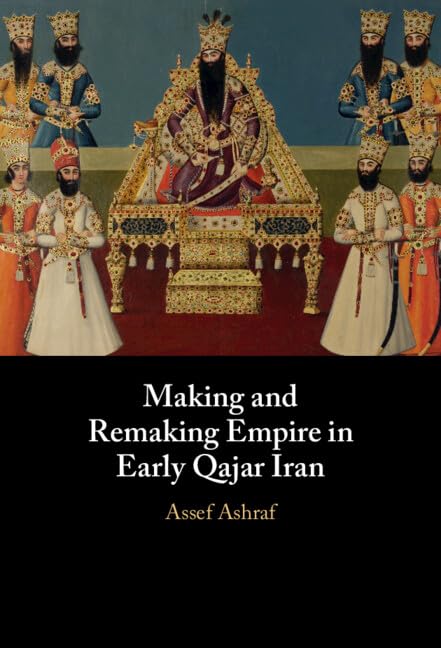
Making and Remaking Empire in Early Qajar Iran by Assef Ashraf
In 1722, the Safavid empire collapsed. An empire that ruled for over two centuries, in its heyday it spanned parts of Central Asia, the Caucasus, and present-day Iran. The decades following its fall were ones of unrest and discord, and it was only with the rise of the Qajars in the 1780s that a level of stability was restored. Assef Ashraf devotes this book to an analysis of the making of the Qajar empire. It adopts a socially-oriented approach to political history - an approach that examines the discourse and political practices, and the centers and peripheries, of empire. Each chapter focuses on a particular practice that was at the heart of Qajar governance - land administration, gift giving, marriage, political correspondence, provincial diplomacy, and territorial conquest and tribal relations. By situating the formation of Qajar Iran in its early nineteenth-century context, Ashraf highlights the overarching themes of transition and change.
'Making and Remaking Empire is a milestone in the study of early Qajar IranThrough sensitive readings of baroque texts and by drawing on an impressive range of archival material, Ashraf succeeds in moving beyond conventional political history to offer a sociologically and anthropologically informed reading of the human relations and codes of behaviour at the heart of Qajar governance. Ashraf's study transcends the stale binary of state and society and invites us to revisit this formative period in the emergence of modern Iran with a fresh, unbiased perspective.' Dominic Parviz Brookshaw, University of Oxford
'Grounded in extensive research and considered reflection on key issues as well as on sources, this book provides a knowledgeable and intellectually stimulating account and interpretation of socio-political developments in the area. It offers important and creative insights that have the potential to transform the historiography of Iran in the so-called Qajar era, for example in its creative exploration of notions of 'empire'. It gives a powerful and convincing demonstration of the value of a 'social approach' to politics and governance whether in its discussion of elite affiliation to the emergent Qajar regime or its consideration of the relations of regional, central, and local politics and administration. Assef Ashraf's clear and thorough analysis of the many-sided 'making' of the Qajar state fill an important gap in the historiography of modern Iran.' Joanna de Groot, University of York
'Grounded in extensive research and considered reflection on key issues as well as on sources, this book provides a knowledgeable and intellectually stimulating account and interpretation of socio-political developments in the area. It offers important and creative insights that have the potential to transform the historiography of Iran in the so-called Qajar era, for example in its creative exploration of notions of 'empire'. It gives a powerful and convincing demonstration of the value of a 'social approach' to politics and governance whether in its discussion of elite affiliation to the emergent Qajar regime or its consideration of the relations of regional, central, and local politics and administration. Assef Ashraf's clear and thorough analysis of the many-sided 'making' of the Qajar state fill an important gap in the historiography of modern Iran.' Joanna de Groot, University of York
Assef Ashraf is University Assistant Professor in Eastern Islamic Lands and the Persian-Speaking World in the Faculty of Asian and Middle Eastern Studies at the University of Cambridge, as well as a Fellow of Pembroke College. Ashraf is also the co-editor of The Persianate World: Rethinking a Shared Sphere (2019).
| SKU | Unavailable |
| ISBN 13 | 9781009361552 |
| ISBN 10 | 1009361554 |
| Title | Making and Remaking Empire in Early Qajar Iran |
| Author | Assef Ashraf |
| Condition | Unavailable |
| Publisher | Cambridge University Press |
| Year published | 2024-02-01 |
| Number of pages | 362 |
| Cover note | Book picture is for illustrative purposes only, actual binding, cover or edition may vary. |
| Note | Unavailable |