


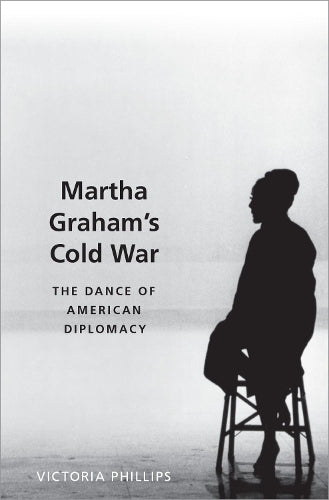
Martha Graham's Cold War by Victoria Phillips
Martha Graham's Cold War frames the story of Martha Graham and her particular brand of dance modernism as pro-Western Cold War propaganda used by the United States government to promote American democracy. Representing every seated president from Dwight D. Eisenhower through Ronald Reagan, Graham performed politics in the global field for over thirty years. Why did the State Department consistently choose Martha Graham? As with other art forms such as jazz or avant-garde paintings, modern dance was seen to demonstrate American values of individualism and freedom; the choreographer used the freed body to make a new dance technique that could find the essence of human narratives. Graham targeted elites and its youth with modern dance to propound the 'universalism' of human rights under the banner of American democracy. In her choreography, argues author Victoria Phillips, Graham recast the stories of the Western canon through female protagonists whom she captured as timeless, seemingly beyond current politics, and in so doing implied superior political and cultural values of the Free World. Centering on powerful yet not demonstrably American female characters, the stories Graham danced seduced and captured the imaginations of elite audiences without seeming to force a determinedly American agenda. When her characters grew mythic on stage, they became the stories of all mankind, as Graham termed it. "My dances are ages old in meaning," she declared. But Graham took the pro-American argument one step further than her artistic compatriots. She added the trope of the frontier to her repertory. In the Cold War, Graham's particular modernism and the woman herself ossified, as did political aims of a cultural diplomacy based on an appeal to foreign elites. Phillips lays bare the side-by-side trajectories between the aging of Graham's choreography, her work as an ambassador, and the political dominance of the United States as a global power. With her tours and Cold War modernism, she demonstrated the power of the individual, immigrants, republicanism, and freedom from walls and metaphorical fences through cultural diplomacy with the unfettered language of movement and dance.
Then there were the Cold War modernistsAs Victoria Phillips demonstrates in her gracefully written, analytically powerful of study of modernism in dance, Martha Graham's Cold War, the U.S. government promoted modern dance as pro-Western Cold War propaganda, supposedly symbolizing the values of democracy, freedom and individualism. * Steven Mintz, Inside Higher Education *
The strength of this superbly researched book lies in the voice it gives to the many diplomats, journalists, and cultural figures with first-hand knowledge of Martha Graham's four decades of cultural diplomacy. Grounded in interviews and primary documents, this is practitioner-oriented diplomatic history at its best. * Institute for Public Diplomacy and Global Communication, George Washington University *
Meticulously researched and impassioned, Martha Graham's Cold War is essential reading for scholars of cultural diplomacy, the Cold War, and the history of dance. * Laura A. Belmonte, Dean, College of Liberal Arts and Human Sciences, Virginia Tech *
This fascinating study shows how Martha Graham wedded the art of modern dance to America's Cold War 'cultural offensive.' In a highly readable and well researched narrative, it contributes to scholarship on mid-century modernism, gender and race in Cold War politics, and the strategic and personal dilemmas presented by propaganda campaigns based on supposedly apolitical cultural messaging. Scholars and general readers alike will appreciate how Victoria Phillips focuses on the era's most innovative dancer to craft her rich history of the Cold War. Highly recommended! * Emily S. Rosenberg, co-editor of Body and Nation: The Global Realm of U.S. Body Politics in the Twentieth Century *
While the book focuses on a single performer, the analysis of Graham serves to brilliantly reveal some essential questions about the complexities, contradictions, and meaning of US cultural diplomacy during the Cold War. * Diplomatica *
Martha Graham's Cold War is a book not to be missed. * H-Diplo *
An ambitious...book that will interest history buffs and dance aficionados. * Kirkus Reviews *
Phillips' book makes an important contribution by studying a prolific choreographer in detail and developing a well-documented, thorough account of her relationship with politics. * Gretchen McLaine, Journal Of Dance Education *
The strength of this superbly researched book lies in the voice it gives to the many diplomats, journalists, and cultural figures with first-hand knowledge of Martha Graham's four decades of cultural diplomacy. Grounded in interviews and primary documents, this is practitioner-oriented diplomatic history at its best. * Institute for Public Diplomacy and Global Communication, George Washington University *
Meticulously researched and impassioned, Martha Graham's Cold War is essential reading for scholars of cultural diplomacy, the Cold War, and the history of dance. * Laura A. Belmonte, Dean, College of Liberal Arts and Human Sciences, Virginia Tech *
This fascinating study shows how Martha Graham wedded the art of modern dance to America's Cold War 'cultural offensive.' In a highly readable and well researched narrative, it contributes to scholarship on mid-century modernism, gender and race in Cold War politics, and the strategic and personal dilemmas presented by propaganda campaigns based on supposedly apolitical cultural messaging. Scholars and general readers alike will appreciate how Victoria Phillips focuses on the era's most innovative dancer to craft her rich history of the Cold War. Highly recommended! * Emily S. Rosenberg, co-editor of Body and Nation: The Global Realm of U.S. Body Politics in the Twentieth Century *
While the book focuses on a single performer, the analysis of Graham serves to brilliantly reveal some essential questions about the complexities, contradictions, and meaning of US cultural diplomacy during the Cold War. * Diplomatica *
Martha Graham's Cold War is a book not to be missed. * H-Diplo *
An ambitious...book that will interest history buffs and dance aficionados. * Kirkus Reviews *
Phillips' book makes an important contribution by studying a prolific choreographer in detail and developing a well-documented, thorough account of her relationship with politics. * Gretchen McLaine, Journal Of Dance Education *
Victoria Phillips specializes in Cold War history, cultural diplomacy, and international relations. Her articles have appeared in such varied publications as the New York Times, American Communist History, Dance Chronicle, and Dance Research Journal. She has curated several exhibits on dance and politics in Europe and Washington, DC. Before her academic career, she was a dancer and then a portfolio manager on Wall Street. Her papers are held at the Library of Congress as the Victoria Phillips Collection.
| SKU | Unavailable |
| ISBN 13 | 9780190610364 |
| ISBN 10 | 0190610360 |
| Title | Martha Graham's Cold War |
| Author | Victoria Phillips |
| Condition | Unavailable |
| Publisher | Oxford University Press Inc |
| Year published | 2020-02-27 |
| Number of pages | 472 |
| Cover note | Book picture is for illustrative purposes only, actual binding, cover or edition may vary. |
| Note | Unavailable |