


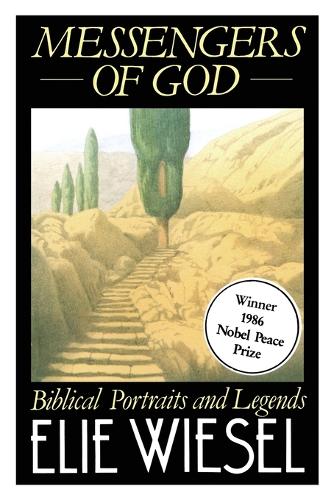
Messengers of God by Elie Wiesel
Elie Wiesel's classic look at Job and seven other Biblical characters as they grapple with their relationship with God and the question of his justice."Wiesel has never allowed himself to be diverted from the role of witness for the martyred Jews and survivors of the Holocaust, and by extension for all those who through the centuries have asked Job's question: 'What is God doing and where is His justice?' Here in a masterful series of mythic portraits, drawing upon Bible tales and the Midrashim (a body of commentary), Wiesel explores 'the distant and haunting figures that molded him': Adam, Cain and Abel, Abraham and Isaac, Jacob, Joseph, and Job. With the dramatic invention of a Father Mapple and the exquisite care of a Talmudic scholar, Wiesel interprets the wellsprings of Jewish religious tradition as the many faces of man's greatness facing the inexplicable. In an intimate relationship with God it is possible to complain, to demand. Adam and Eve in sinning "cried out" against the injustice of their entrapment; Cain assaulted God rather than his brother; and Abraham's agreement to sacrifice his son placed the burden of guilt on Him who demanded it. As for Job, Wiesel concludes that he abdicated his defiance as did the confessing Communists of Stalin's time to 'underline the implausibility' of his trial, and thus become the accuser. Wiesel's concern with the imponderables of fate seems to move from strength to strength" (Kirkus Reviews).
Born in Sighet, Romania, Elie Wiesel was the son of a grocer. In 1944 he and his family were deported, along with other Jews, to the Nazi death camps. His father died in Buchenwald and his mother and his younger sisters at Auschwitz. (Wiesel did not learn until after the war that his older sisters had also survived.) Upon liberation from the camps, Wiesel boarded a train for Western Europe with other orphans. The train arrived in France, where he chose to remain. He settled first in Normandy and later in Paris, where he completed his education at the Sorbonne (from 1948 to 1951). To support himself, he did whatever he could, including tutoring, directing a choir, and translating. Eventually he began working as a reporter for various French and Jewish publications. Emotionally unable at first to write about his experience of the Holocaust, in the mid-1950s the novelist Francois Mauriac urged him to speak out and tell the world of his experiences. The result was La Nuit (1958), later translated as Night (1960), the story of a teenage boy plagued with guilt for having survived the death camps and for questioning his religious faith. Before the book was published, Wiesel had moved to New York (in 1956), where he continued writing and eventually began teaching. He became a naturalized American citizen in 1963, following a long recuperation from a car accident. Since the publication of Night, Wiesel has become a major writer, literary critic, and journalist. As a writer steeped in the Hasidic tradition and concerned with the Holocaust he survived, he has written on the problem of persecution and the meaning of being a Jew. Dawn (1960) is an illuminating document about terrorists in Palestine. In The Accident (1961), Eliezer, a Holocaust survivor, can not seem to escape the past. Other notable works include The Gates of the Forest (1964) and Twilight (1988), which explore the themes of human suffering and a belief in God. Wiesel has received a number of awards and honors for his literary work, including the William and Janice Epstein Fiction Award in 1965, the Jewish Heritage Award in 1966, the Prix Medicis in 1969, and the Prix Livre-International in 1980. As a result of his work in combating human cruelty and in advocating justice, Wiesel was awarded the Nobel Peace Prize in 1986. He has also served as chairman of the U.S. Holocaust Memorial Council and spoke at the dedication of the Holocaust Museum in Washington, D.C., in 1993.
| SKU | Unavailable |
| ISBN 13 | 9780671541347 |
| ISBN 10 | 067154134X |
| Title | Messengers of God |
| Author | Elie Wiesel |
| Condition | Unavailable |
| Binding Type | Paperback |
| Publisher | Simon & Schuster Ltd |
| Year published | 1986-01-01 |
| Number of pages | 256 |
| Cover note | Book picture is for illustrative purposes only, actual binding, cover or edition may vary. |
| Note | Unavailable |