


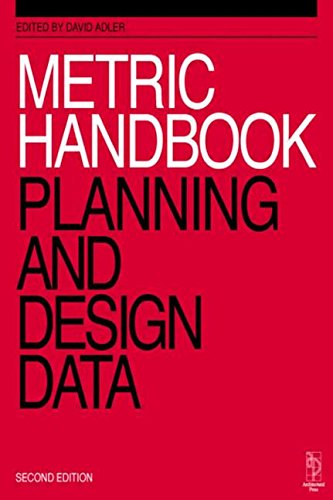
Metric Handbook by David Adler
Originally devised as a guide for converting from imperial to metric measurements, "The Metric Handbook" has since been totally transformed into a major international handbook of planning and design data. The second edition has been completely updated, with most chapters being totally rewritten, to meet the needs of the modern designer. The book contains nearly 50 chapters dealing with all the principal building types from airports, factories and warehouses, offices shops and hospitals, to schools, religious buildings and libraries. For each building type "The Metric Handbook" gives the basic design requirements and all the principal dimensional data. Several chapters deal with general aspects of building such as materials, lighting, acoustics and tropical design. There are also sections on general design data, including details of human dimensions and space requirements. It is a unique authoritative reference for solving everyday planning problems. In its various editions, it has sold over 100,000 copies worldwide, and continues to be a reference work belonging on every design office desk or drawing board. It is the source of information to solve your everyday planning problems. It is an easy to use provider of all data needed for the job. It keeps you up to date with all the latest information.A few years ago I was at Open School Night for my middle son. His fourth grade teacher was the same one my eldest son had seven years earlier and the same teacher I had sometime in the 1950s. The teacher looked at me, smiled, and then told the roomful of parents, A long time ago, when I just started teaching, David was in my class. She smiled again and said, I went to the principal and asked, 'What should I do with Adler? He's always dreaming.' 'Leave him alone, ' the principal answered. 'Maybe one day he'll be a writer.'
That's her story, not mine. But I know I did dream through much of my early school years and I did become a writer.
Dreamers become writers and for me, being a published writer is a dream come true.
I write both fiction and non-fiction.
I begin my fiction with the main character. The story comes later. Of course, since I'll be spending a lot of time with each main character, why not have him or her be someone I like? Andy Russell is based, loosely, on a beloved member of my family. He's fun to write about and the boy who inspired the character is even more fun to know. Cam Jansen is based even more loosely on a classmate of mine in the first grade whom we all envied because we thought he had a photographic memory. Now, especially when my children remind me of some promise they said I made, I really envy Cam's amazing memory. I have really enjoyed writing about Cam Jansen and her many adventures.
For my books of non-fiction I write about subjects I find fascinating. My first biography was Our Golda: The Life of Golda Meir. To research that book, I bought a 1905 set of encyclopedia. Those books told me what each of the places Golda Meir lived in were like when she lived there.
I've written many other biographies, including books about Martin Luther King, Jr; George Washington; Abraham Lincoln; Helen Keller; Harriet Tubman; Anne Frank; and many others in my Picture Book Biography series.
I've been a Yankee and a Lou Gehrig fan for decades so I wrote Lou Gehrig: The Luckiest Man. It's more the story of his great courage than his baseball playing. Children face all sorts of challenges and it's my hope that some will be inspired by the courage of Lou Gehrig. I am working now on another book about a courageous man, Janusz Korczak.
My book One Yellow Daffodil is fiction, too, but it's based on scores of interviews I did with Holocaust survivors for my books We Remember the Holocaust, Child of the Warsaw Ghetto, The Number on My Grandfather's Arm, and Hiding from the Nazis. The stories I heard were compelling. One Yellow Daffodil is both a look to the past and to the future, and expresses my belief in the great spirit and strength of our children.
I love math and was a math teacher for many years, so it was fun for me to write several math books including Fraction Fun, Calculator Riddles, and Shape Up! Fun with Triangles and Other Polygons.
In my office I have this sign, Don't Think. Just Write! and that's how I work. I try not to worry about each word, even each sentence or paragraph. For me stories evolve. Writing is a process. I rewrite each sentence, each manuscript, many times. And I work with my editors. I look forward to their suggestions, their help in the almost endless rewrite process.
Well, it's time to get back to dreaming, and to writing, my dream of a job.
David A. Adler is the author of more than 175 children's books, including the YoungCam Jansen series. He lives in Woodmere, New York.
| SKU | Unavailable |
| ISBN 13 | 9780750608992 |
| ISBN 10 | 0750608994 |
| Title | Metric Handbook |
| Author | David Adler |
| Condition | Unavailable |
| Binding Type | Paperback |
| Publisher | Taylor & Francis Ltd |
| Year published | 1999-04-22 |
| Number of pages | 512 |
| Cover note | Book picture is for illustrative purposes only, actual binding, cover or edition may vary. |
| Note | Unavailable |