


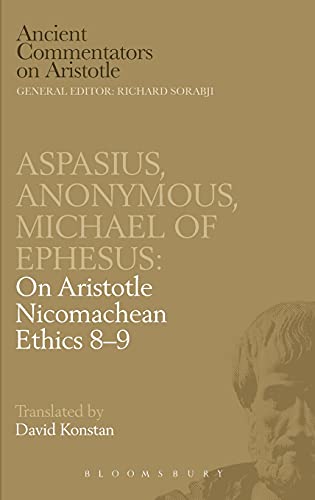
Michael of Ephesus/Aspasius/Anonymus by Richard Sorabji
Aristotle devotes books 8-9 of the "Nicomachean Ethics" to friendship, distinguishing three kinds: a primary kind motivated by the other's character; and other kinds motivated by utility or pleasure. He takes up Plato's idea that one knows oneself better as reflected in another's eyes, as providing one of the benefits of friendship, and he also sees true friendship as modelled on true self-love. He further compares friendship with justice, and illustrates the ubiquity of friendship by referring to the way in which we help wayfarers as if they were kin (oikeion), a word he takes from Plato's discussion of love. In many of these respects he probably influenced the Stoic theory of justice as based on the natural kinship (oikeiotes) one feels initially for oneself at birth and, eventually, for lost wayfarers. Of the three commentaries translated here, that by the second-century AD Aristotelian Aspasius is the earliest extant commentary on Aristotle; the second is by Michael of Ephesus in the twelfth century; the third is of unknown date and authorship. Aspasius worries whether there is only one kind of friendship with a single definition. But he plumps for a verdict not given by Aristotle, that the primary kind of friendship serves as a focal point for defining the other two. Aspasius picks up connections with his Stoic contemporaries. Michael cites Christians and draws from Neoplatonists the idea that there is a self-aware part of the soul, and that Aristotle saw individuals as bundles of properties.-
 Simplicius: On Aristotle On the Heavens 1.3-4
-
 Eustratius on Aristotle's Posterior Analytics Book 2.7-10
-
 Simplicius
-
 Philoponus
-
 Olympiodorus: On Aristotle Meteorology 2-3
-
 Themistius: On Aristotle Metaphysics 12
-
 Michael of Ephesus: On Aristotle's Nicomachean Ethics 10 with Themistius: On Virtue
-
 Alexander of Aphrodisias: On Aristotle Topics 3
-
 Alexander of Aphrodisias: On Aristotle Topics 2
-
 Iamblichus: On the General Science of Mathematics
-
 Aeneas of Gaza: Theophrastus with Zacharias of Mytilene: Ammonius
-
 Philoponus: On Aristotle Meteorology 1.4-9, 12
-
 Proclus: On Providence
-
 Simplicius: On Aristotle On the Heavens 1.2-3
-
 'Simplicius': On Aristotle On the Soul 3.6-13
-
 Simplicius: On Aristotle On the Soul 1.1-2.4
-
 Simplicius: On Aristotle Physics 1.5-9
-
 Philoponus: On Aristotle Posterior Analytics 1.9-18
-
 Philoponus: Against Proclus On the Eternity of the World 9-11
-
 Philoponus: On Aristotle On the Soul 2.1-6
-
 Philoponus': On Aristotle On the Soul 3.1-8
-
 Simplicius: On Aristotle On the Heavens 2.10-14
-
 Philoponus: On Aristotle On the Soul 1.1-2
-
 Alexander of Aphrodisias: On Aristotle Prior Analytics 1.14-22
-
 Simplicius: On Aristotle On the Heavens 2.1-9
-
 Simplicius: On Aristotle Physics 1.3-4
-
 Aspasius: On Aristotle Nicomachean Ethics 1-4, 7-8
-
 Alexander of Aphrodisias: On the Soul
-
 Simplicius: On Aristotle On the Heavens 3.1-7
-
 Simplicius: On Aristotle Physics 8.1-5
-
 Simplicius: On Aristotle Physics 5
-
 Simplicius: On Aristotle On the Heavens 3.7-4.6
-
 Simplicius: On Aristotle On the Heavens 1.5-9
-
 Themistius: On Aristotle Physics 4
-
 Philoponus: On Aristotle Physics 4.10-14
-
 Philoponus: Against Proclus On the Eternity of the World 6-8
-
 Philoponus: On Aristotle Physics 5-8 with Simplicius: On Aristotle on the Void
-
 Boethius: On Aristotle on Interpretation 4-6
-
 Philoponus: On Aristotle Physics 4.1-5
-
 Themistius: On Aristotle Physics 1-3
-
 Philoponus: Against Proclus On the Eternity of the World 1-5
-
 Themistius: On Aristotle Physics 5-8
-
 Philoponus: On Aristotle Physics 4.6-9
-
 Boethius: On Aristotle On Interpretation 1-3
-
 Syrianus: On Aristotle Metaphysics 13-14
-
 Ammonius: On Aristotle On Interpretation 1-8
-
 Philoponus: On Aristotle Physics 1.1-3
-
 Philoponus: On Aristotle On Coming to be and Perishing 2.5-11


David Konstan is John Rowe Workman Distinguished Professor of Classics and Professor of Comparative Literature at Brown University.
| SKU | Unavailable |
| ISBN 13 | 9780715630716 |
| ISBN 10 | 0715630717 |
| Title | Michael of Ephesus/Aspasius/Anonymus |
| Author | Richard Sorabji |
| Series | Ancient Commentators On Aristotle |
| Condition | Unavailable |
| Binding Type | Hardback |
| Publisher | Bloomsbury Publishing PLC |
| Year published | 2001-09-27 |
| Number of pages | 240 |
| Cover note | Book picture is for illustrative purposes only, actual binding, cover or edition may vary. |
| Note | Unavailable |