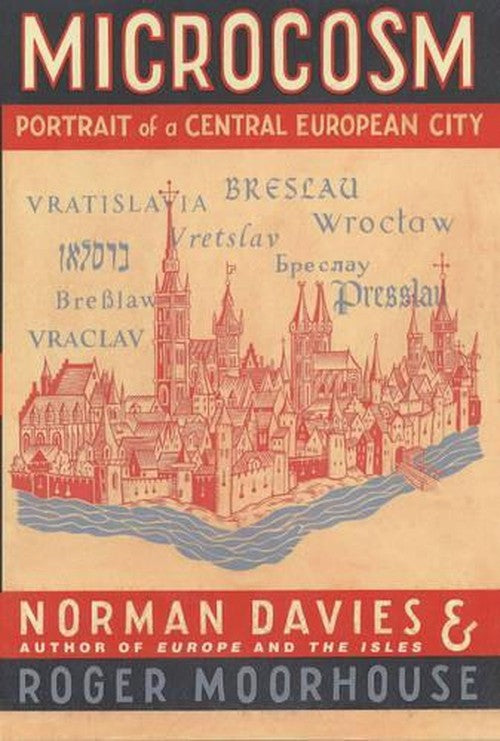
Microcosm by Norman Davies

Microcosm by Norman Davies

Regular price
Checking stock...
Regular price
Checking stock...
Summary

In order to present a portrait of Central Europe, the authors study the history of Breslau, one of its major cities. The history of this city embodies all the experiences which have made Central Europe what it is, such as the rich mixture of nationalities and cultures.

The feel-good place to buy books
  • Free US shipping over $15
  • Buying preloved emits 41% less CO2 than new
  • Millions of affordable books
  • Give your books a new home - sell them back to us!

Microcosm by Norman Davies

In May 1945, the city of Breslau was annihilated by the Soviet Red Army. At the beginning of February the Russians had laid seige to the city, an ordeal that was to last for nearly five months. Much of Breslau was destroyed, thousands of its inhabitants were killed. Breslau surrendered four days after Berlin and was thus the last Fortress of the Reich to fall and one of the very last areas in Germany to surrender. The story of Central Europe is anything but simple. As the region in between East and West Europe, it has always been endowed with a rich variety of migrants and settlers, and has repeatedly been the scene of nomadic invasions, mixed settlements and military conquests. As a result, the people of Central Europe have witnessed a profusion of languages, cultures, religions and nationalities. The two most important waves of settlement came from the Germans and the Slavs, but Central Europe also became the great haven for Jews. In the centuries when Jewish people were deported from England, persecuted in Germany and expelled from Russian, they naturally congregated in the middle. The Jewishness of Central Europe has been subjected to both Fascism and Communism in succession. This ordeal lasted for about 50 years, and the damage to life and liberty was incalculable. In order to present a portrait of Central Europe, the authors of this work study the history of one of its main cities - Breslau. As the traditional capital of Silesia, Breslau rose to prominence as a trading centre and became one of the great commercial cities of medieval Europe. In due course it became the second city of the kingdom of Bohemia and a major city of the Hapsburg lands. The third largest German city of the mid-19th century, Breslau's population reached one million in 1945, before the bitter German defence of the city against the Soviets wrought almost total destruction. Transferred to Poland after the war, the city has risen from the ruins of the war and is once again a thriving economic and cultural centre of the region. The history of Silesia's main city can be seen as a fascinating tale in its own right, but it is more than that. It embodies all the experiences which have made Central Europe what it is: the rich mixture of nationalities and cultures; the German settlement and the reflux of the Slavs; a Jewish presence of exceptional distinction; a turbulent succession of Imperial rulers; and the shattering exposure to both Nazis and Stalinists. In short, it is a Central European microcosm.
A brilliant exploration of what it means to be Central European by telling the remarkable story of Silesia's principal city
Norman Davies is Professor Emeritus of the University of London, a Senior Member of Wolfson College, Oxford, and the author of several books on European history, including God's Playground and Europe. Roger Moorhouse was the researcher for Davies' Europe and The Isles.
SKU Unavailable
ISBN 13 9780224062435
ISBN 10 0224062433
Title Microcosm
Author Norman Davies
Condition Unavailable
Binding Type Hardback
Publisher Vintage Publishing
Year published 2002-03-28
Number of pages 608
Cover note Book picture is for illustrative purposes only, actual binding, cover or edition may vary.