


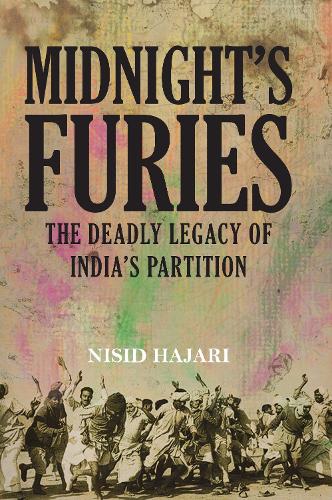
Midnight's Furies by Nisid Hajari
After centuries of British rule, nobody expected Indian Independence and the birth of Pakistan to be so bloody — they were supposed to be the answer to the dreams of Muslims and Hindus. Jawaharlal Nehru, Gandhi’s protégé and the political leader of India, believed Indians were an inherently nonviolent, peaceful people. Pakistan’s founder, Mohammad Ali Jinnah, was a secular lawyer, not a firebrand. But in August 1946, exactly a year before Independence, Calcutta erupted in street-gang fighting. A cycle of riots — targeting Hindus, then Muslims, then Sikhs — spiraled out of control. As the summer of 1947 approached, all three groups were heavily armed and on edge, and the British rushed to leave. Hell let loose. Trains carried Muslims west and Hindus east to their slaughter. Some of the most brutal and widespread ethnic cleansing in modern history erupted on both sides of the new border, carving a gulf between India and Pakistan that remains a root cause of many evils. From jihadi terrorism to nuclear proliferation, the searing tale told in Midnight’s Furies explains all too many of the headlines we read today.
'History is about grand cultural and geographical forces within which individual leaders must, nevertheless, take moral responsibility for better and worse outcomesNisid Hajari’s meticulous study of India’s birth captures this dichotomy brilliantly.' -- Robert D. Kaplan, author of Monsoon: The Indian Ocean and the Future of American Power
'Pakistan is perhaps the world’s most dangerous country — a combustible mix of nuclear weapons, jihadis, bloody borders and a dysfunctional state. You can only truly understand the country by going to its roots. Nisid Hajari does just that in this powerful, intelligent, and beautifully written book. He finds in India’s partition and its aftermath mistakes, compromises and cowardice as well as all the ideology, venom, and violence that have now erupted onto the global stage. Hajari presents the history like a detective story and you will be swept along. Except in this case, none of us knows how it will end.' -- Fareed Zakaria, author of The Post-American World
'India’s partition in 1947 was a traumatic event unparalleled in its human toll since World War II. Its legacy continues to haunt both India and Pakistan and threaten global security. Well researched and eminently readable, this haunting account puts into the proper perspective both history and current events.' -- Vali Nasr, author of The Shia Revival
'Pakistan is perhaps the world’s most dangerous country — a combustible mix of nuclear weapons, jihadis, bloody borders and a dysfunctional state. You can only truly understand the country by going to its roots. Nisid Hajari does just that in this powerful, intelligent, and beautifully written book. He finds in India’s partition and its aftermath mistakes, compromises and cowardice as well as all the ideology, venom, and violence that have now erupted onto the global stage. Hajari presents the history like a detective story and you will be swept along. Except in this case, none of us knows how it will end.' -- Fareed Zakaria, author of The Post-American World
'India’s partition in 1947 was a traumatic event unparalleled in its human toll since World War II. Its legacy continues to haunt both India and Pakistan and threaten global security. Well researched and eminently readable, this haunting account puts into the proper perspective both history and current events.' -- Vali Nasr, author of The Shia Revival
NISID HAJARI is the Asia Editor for Bloomberg View. Prior to Bloomberg, he spent a decade at Newsweek magazine, as Asia Editor, Foreign Editor, and eventually co-editor. He has appeared frequently as a commentator on foreign affairs on NPR, NBC and CNN, and is a member of the Council on Foreign Relations.
| SKU | Unavailable |
| ISBN 13 | 9781445647937 |
| ISBN 10 | 1445647931 |
| Title | Midnight's Furies |
| Author | Nisid Hajari |
| Condition | Unavailable |
| Binding Type | Hardback |
| Publisher | Amberley Publishing |
| Year published | 2015-06-15 |
| Number of pages | 352 |
| Cover note | Book picture is for illustrative purposes only, actual binding, cover or edition may vary. |
| Note | Unavailable |