
"Much Ado About Nothing"


World of Books
The feel-good place to buy books
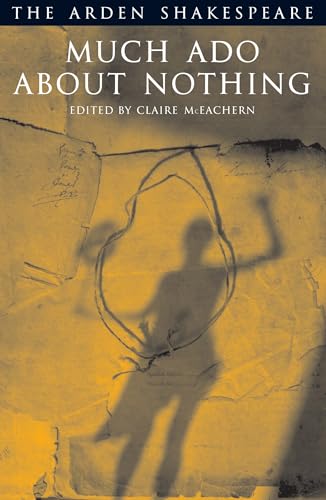
"Much Ado About Nothing" by William Shakespeare
Much Ado About Nothing of the Ratna Sagar Shakespeare Series is enriched with complete text of the original play, plenty of short notes that explain and interpret the text, summary of each scene, as well as useful commentary on the life and times of Shakespeare, Elizabethan theatre, sources and genre, characters, plot, themes, and motifs, literary devices and figures of speech. A comedy of errors, the title of the play is justified by the utter confusion in the plot that arises out of nothing. Replete with sparkling dialogues, the play has also been described as a comedy of wit. This edition of Much Ado About Nothing is enriched with exhaustive annotations and notes.This enriched edition of Much Ado About Nothing has exhaustive annotations and notes. As suggested by its title, the play is a comedy of errors in which a lot of fuss and confusion is created over nothing. The title also plays on the word 'nothing', pronounced as 'noting' in Elizabethan English. 'Noting' refers to the manner in which people note or eavesdrop, and pass on information. The action over the course of the play largely arises because of noting and deceit, as the characters are directly or indirectly affected by eavesdropping and gossip. Claudio and Hero's relationship suffers due to the malicious misinformation of Don John and Borachio. On the other hand, Benedick and Beatrice's relationship develops as a result of the well-intended deceit and gossip of Don Pedro, Claudio, Leonato, Hero, and Ursula. Set in Messina, Italy, the action of the play mostly takes place in and around the house of Leonato, the Governor of Messina, who lives with his daughter, Hero, and his witty niece, Beatrice. The play commences with Don Pedro, the Prince of Arragon, and his followers Benedick and Claudio visiting Leonato with the prince's illegitimate brother Don John, who had rebelled against him but is now reconciled. It is revealed that Claudio loves Hero and wishes to propose to her. While the Claudio-Hero relationship forms the main plot of the play, the sub-plot is provided by the love-hate relationship between Benedick and Beatrice, whose interactions oscillate between fondness and witty sarcasm from the very beginning. In the initial part of the play, there is a masked dance in which Don Pedro pretends to be Claudio, woos Hero on his behalf, and asks Leonato for Hero's hand in marriage to Claudio. As all is settled for the prospective marriage of Claudio and Hero within a week, the bitter and sullen Don John concocts a plan with his underling Borachio to spoil the happiness of Claudio, the 'young start-up' who 'hath all the glory of my overthrow'. As a game of deceit and manipulation begins, Don John and Borachio execute their plan to lead Claudio into believing Hero's infidelity. An enraged Claudio shames and rejects Hero in front of the wedding congregation the next day. Leonato is devastated, and Hero faints, at which Claudio and Don Pedro leave her for dead. Friar Francis believes in Hero's innocence, and devises the plan to publish the report of her death so as to convert the slander against her into pity, and make Claudio realize her worth and repent for disgracing her. Meanwhile, the scene shifts to the members of the Watch, with the head constable Dogberry, his partner Verges, and two watchmen. Although they are the comedians of the play, these farcical detectives are the ones who finally uncover the truth of Don John's villainy. Once Don John's plot is revealed, Don Pedro and Claudio repent for their action and apologize to Leonato, who asks Claudio to hang an epitaph on Hero's 'tomb', and then marry his 'niece', who is 'the copy of my child that's dead', as penance. Claudio agrees, and on the day of the wedding the lady is revealed to be none other than Hero herself. With the resolution of the Claudio-Hero relationship, Benedick and Beatrice too confess their love for each other, but not without the customary bout of wit. A messenger arrives to inform all that Don John has been captured while trying to flee. With poetic justice served and all conflicts resolved, the play ends with a celebratory dance.
Advisory Board: David Bevington is the Phyllis Fay Horton Distinguished Service Professor in the Humanities at the University of Chicago. A renowned text scholar, he has edited several Shakespeare editions including the Bantam Shakespeare in individual paperback volumes, The Complete Works of Shakespeare, (Longman, 2003), and Troilus and Cressida (Arden, 1998). He teaches courses in Shakespeare, Renaissance Drama, and Medieval Drama. Barbara Gaines is the founder and Artistic Director of the Chicago Shakespeare Theater. She has directed over 25 productions at Chicago Shakespeare, and she serves on the artistic directorate of
Shakespeare's Globe Theatre in London as well as on Northwestern University's Board of Trustees. Peter Holland is the McMeel Family Chair in Shakespeare Studies at the University of Notre Dame. One of the central figures in performance-oriented Shakespeare criticism, he has also edited many
Shakespeare plays, including A Midsummer Night's Dream for the Oxford Shakespeare series. He is also general editor of Shakespeare Survey and co-general editor (with Stanley Wells) of Oxford Shakespeare Topics. Contributors: Professor Douglas Lanier - Douglas Lanier is an Associate Professor of English at the University of New Hampshire. His publications include Shakescorp Noir in Shakespeare Quarterly 53.2 (Summer 2002) and Nostalgia and Theatricality in Shakespeare the Movie II (eds. Richard Burt and Lynda Boose, Routledge, 2003), and the book, Shakespeare and Modern Popular Culture (Oxford University Press, 2002). Professor Jill Levenson - Jill L. Levenson is a Professor of English at Trinity College at the University of Toronto. She has written and edited numerous essays and books including Romeo and Juliet for the Manchester University Press's series Shakespeare in Performance (1987), Shakespeare and the Twentieth Century (with Jonathan Bate and Dieter Mehl), and the Oxford edition of Romeo and Juliet (2000). Currently she is writing a book on Shakespeare and modern drama for Shakespeare Topics, a series published by Oxford University Press. Professor Lois Potter - Lois Potter is Ned B. Allen Professor of English at the University of Delaware. She has also taught in England, France, and Japan, attending and reviewing as many plays as possible. Her publications include the Arden edition of The Two Noble Kinsmen and Othello for the Manchester University Press's series Shakespeare in Performance. Ms. Janet Suzman - Janet Suzman was trained at LAMDA and is an honorary associate artist of the Royal Shakespeare Company. Her work there has included The Wars of the Roses, As You Like It, The Taming of the Shrew, Much Ado About Nothing, Love's Labour's Lost, and The Merchant of Venice. She has been awarded numerous honorary degrees and was nominated for an Academy Award in 1971 for her performance in Nicholas and Alexandra. Her acclaimed 1990 direction of Othello in Johannesburg, South Africa is considered to be one of the most powerful productions of the play. Mr. Andrew Wade - Andrew Wade was Head of Voice for the Royal Shakespeare Company, 1990 - 2003 and Voice Assistant Director from 1987-1990. During this time he worked on 170 productions and with more than 80 directors. Along with Cicely Berry, Andrew recorded Working Shakespeare, the DVD series on Voice and Shakespeare, and he was the verse consultant for the movie Shakespeare In Love. In 2000, he won a Bronze Award from the New York International Radio Festival for the series Lifespan, which he co-directed and devised. He works widely teaching, lecturing and coaching throughout the world. Marie Macaisa is a lifelong fan of Shakespeare who has seen at least one theatrical production of nearly all his plays (she's waiting for Henry VIII). Her first career, lasting 20 years, was in high tech; she has a B.S. in Computer Science from MIT and a M.S. in Artificial Intelligence from the University of Pennsylvania. For the last two years, she has devoted herself to the Sourcebooks Shakespeare Experience. Dominique Raccah is founder, president and publisher of Sourcebooks. Born in Paris, France, she has a bachelor's degree in psychology and a master's in quantitative psychology from the University of Illinois. She also serves as series editor of Poetry Speaks and Poetry Speaks to Children.
Shakespeare's Globe Theatre in London as well as on Northwestern University's Board of Trustees. Peter Holland is the McMeel Family Chair in Shakespeare Studies at the University of Notre Dame. One of the central figures in performance-oriented Shakespeare criticism, he has also edited many
Shakespeare plays, including A Midsummer Night's Dream for the Oxford Shakespeare series. He is also general editor of Shakespeare Survey and co-general editor (with Stanley Wells) of Oxford Shakespeare Topics. Contributors: Professor Douglas Lanier - Douglas Lanier is an Associate Professor of English at the University of New Hampshire. His publications include Shakescorp Noir in Shakespeare Quarterly 53.2 (Summer 2002) and Nostalgia and Theatricality in Shakespeare the Movie II (eds. Richard Burt and Lynda Boose, Routledge, 2003), and the book, Shakespeare and Modern Popular Culture (Oxford University Press, 2002). Professor Jill Levenson - Jill L. Levenson is a Professor of English at Trinity College at the University of Toronto. She has written and edited numerous essays and books including Romeo and Juliet for the Manchester University Press's series Shakespeare in Performance (1987), Shakespeare and the Twentieth Century (with Jonathan Bate and Dieter Mehl), and the Oxford edition of Romeo and Juliet (2000). Currently she is writing a book on Shakespeare and modern drama for Shakespeare Topics, a series published by Oxford University Press. Professor Lois Potter - Lois Potter is Ned B. Allen Professor of English at the University of Delaware. She has also taught in England, France, and Japan, attending and reviewing as many plays as possible. Her publications include the Arden edition of The Two Noble Kinsmen and Othello for the Manchester University Press's series Shakespeare in Performance. Ms. Janet Suzman - Janet Suzman was trained at LAMDA and is an honorary associate artist of the Royal Shakespeare Company. Her work there has included The Wars of the Roses, As You Like It, The Taming of the Shrew, Much Ado About Nothing, Love's Labour's Lost, and The Merchant of Venice. She has been awarded numerous honorary degrees and was nominated for an Academy Award in 1971 for her performance in Nicholas and Alexandra. Her acclaimed 1990 direction of Othello in Johannesburg, South Africa is considered to be one of the most powerful productions of the play. Mr. Andrew Wade - Andrew Wade was Head of Voice for the Royal Shakespeare Company, 1990 - 2003 and Voice Assistant Director from 1987-1990. During this time he worked on 170 productions and with more than 80 directors. Along with Cicely Berry, Andrew recorded Working Shakespeare, the DVD series on Voice and Shakespeare, and he was the verse consultant for the movie Shakespeare In Love. In 2000, he won a Bronze Award from the New York International Radio Festival for the series Lifespan, which he co-directed and devised. He works widely teaching, lecturing and coaching throughout the world. Marie Macaisa is a lifelong fan of Shakespeare who has seen at least one theatrical production of nearly all his plays (she's waiting for Henry VIII). Her first career, lasting 20 years, was in high tech; she has a B.S. in Computer Science from MIT and a M.S. in Artificial Intelligence from the University of Pennsylvania. For the last two years, she has devoted herself to the Sourcebooks Shakespeare Experience. Dominique Raccah is founder, president and publisher of Sourcebooks. Born in Paris, France, she has a bachelor's degree in psychology and a master's in quantitative psychology from the University of Illinois. She also serves as series editor of Poetry Speaks and Poetry Speaks to Children.
| SKU | Unavailable |
| ISBN 13 | 9781903436837 |
| ISBN 10 | 1903436834 |
| Title | "Much Ado About Nothing" |
| Author | William Shakespeare |
| Series | The Arden Shakespeare |
| Condition | Unavailable |
| Binding Type | Paperback |
| Publisher | Bloomsbury Publishing PLC |
| Year published | 2005-09-26 |
| Number of pages | 368 |
| Cover note | Book picture is for illustrative purposes only, actual binding, cover or edition may vary. |
| Note | Unavailable |