


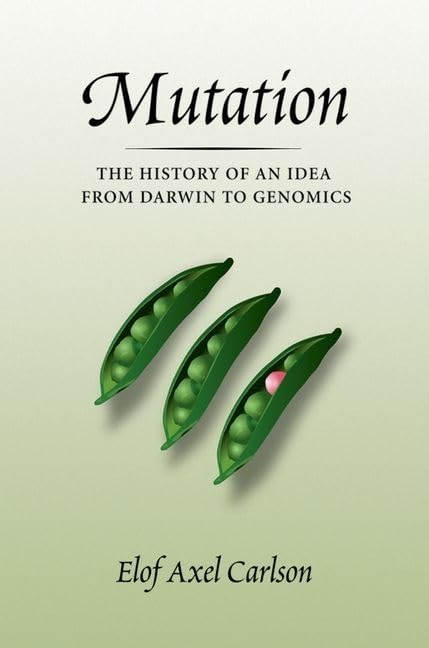
Mutation by Elof Axel Carlson Phd
Today, most scientists regard the term "mutation" as a description of a change in an individual gene, and more precisely as some minute alteration of the DNA of that gene, especially a nucleotide substitution. But the idea of mutation has changed considerably from the pre-Mendelian concepts of Darwin's generation, who viewed "fluctuating variations" as the raw material on which evolution acted, to today's up-to-the-minute genomic context of mutation. Mutation: The History of an Idea from Darwin to Genomics explores six generations of mutation research, providing the background--the people and the ideas--for this biological journey.After exploring Darwin's and Francis Galton's concepts of mutation, Carlson shows how the 1900 rediscovery of Gregor Mendel's experiments let to a discontinuous model of evolution by mutation and how cytological investigations led to the chromosome theory of heredity of classical genetics in which there was random mutation in genes. Carlson details how Mendelian and biometric approaches to heredity and evolution were closely tied and how induction of mutations by radiation and chemical mutagens led to biochemical investigations of gene action, shifting attention to the chemistry of the gene. The interpretation of the gene as DNA and the deciphering of the genetic code then gave rise to molecular interpretations of mutation, views that also impacted evolutionary biology, population genetics, commercial development of plants and animals, and human genetics.
This book shows how generational definitions or assessments of mutation have responded to the technologies added to science and the experiments that abounded with the inquiries of each successive generation. These observations are combined with an exploration of how the nonscientific public has shifted its understanding and concern about mutations over the past 150 or more years. Carlson's historical approach in this book--examining the evolution of a concept--reveals the way science works, incrementally by small steps of additions and replacements rather than by dramatic, and rare, paradigm shifts.
Elof Axel Carlson (born 1931) was raised in Brooklyn, New York, and attended New York University for his B.A. degree. He went to Indiana University to study genetics with Nobelist H. J. Muller, completing his Ph.D. in 1958. He then took a position as Lecturer at Queen's University in Kingston,
Ontario and in 1960 accepted a position at UCLA where he sponsored six students for their Ph.D. degrees. In 1968, Carlson moved to Stony Brook University and in 1974 he was awarded the statewide title of Distinguished Teaching Professor. He retired from Stony Brook University in 2000 and moved to
Bloomington, Indiana, where he is a Visiting Scholar in Indiana University's Institute for Advanced Study. Carlson is a geneticist, historian of science, and writer. He has authored or edited 13 books, including The Gene: A Critical History; Genes, Radiation, and Society: the Life and Work of H. J. Muller; The Unfit: A History of a Bad Idea; Mendel's Legacy: A History of Classical Genetics; and The 7
Sexes: Biology of Sex Determination. He also has written a science column, Life Lines, which has appeared since 1997 in the North Shore Long Island newspapers of publisher Leah Dunaieff. Carlson is a Fellow of the American Association for the Advancement of Science and recipient, in 1972, of the Harbison Award for Gifted Teaching from the Danforth foundation. He is married to Nedra (nü¾Ž–”¼e Miller) Carlson and they have five children, 12 grandchildren, and three great-grandchildren.
| SKU | Unavailable |
| ISBN 13 | 9781936113309 |
| ISBN 10 | 1936113309 |
| Title | Mutation |
| Author | Elof Axel Carlson Phd |
| Condition | Unavailable |
| Binding Type | Hardback |
| Publisher | Cold Spring Harbor Laboratory Press,U.S. |
| Year published | 2011-06-03 |
| Number of pages | 171 |
| Cover note | Book picture is for illustrative purposes only, actual binding, cover or edition may vary. |
| Note | Unavailable |