
The Natural History of Religion


World of Books
The feel-good place to buy books
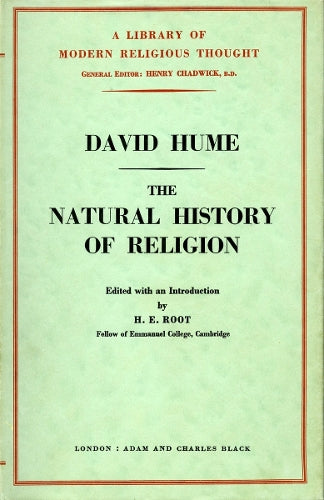
The Natural History of Religion by David Hume
Hume begins with the observation that there is much variety in people's taste (or the aesthetic judgments people make). However, Hume argues that there is a common mechanism in human nature that gives rise to, and often even provides justification for, such judgments. He takes this aesthetic sense to be quite similar to the moral sense for which he argues in his Book 3 of A Treatise of Human Nature (1739-1740) and in An Enquiry Concerning the Principles of Morals (1751). Furthermore, he argues that this still leaves room for the ability to refine one's aesthetic palate. (Fieser, 2006, 2) Hume took as his premise that the great diversity and disagreement regarding matters of taste had two basic sources - sentiment, which was to some degree naturally varying, and critical facility, which could be cultivated. Each person is a combination of these of two sources, and Hume endeavors to delineate the admirable qualities of a critic, that they might augment their natural sense of beauty into a reliable faculty of judgment. There are a variety of qualities of the good critic that he describes, each of which contributes to an ultimately reliable and just ability to judge.
"A minor classic.. The essay has all the celebrated clarity and incisiveness of Hume, and it provides us, in a short and readable form, with the substance of the beliefs about the origins of religion which dominated the first attempts of later and more scientific writers to account for the rise and development of religion." Philosophy "A philosophical classic that caused considerable stir in its time. It is good to have a new editions of this brief work completely edited for the use of modern students." Peabody Journal of Education "Hume's view of religion was one-side and his anthropology out of date, but his blows were shrewd. In the historical development of modern theology his challenge has a point of departure; and even today, as the editor says, unless we have an answer to him our faith is unreal." The Times Literary Supplement
Hume, David: - David Hume (/hjuːm/; born David Home; 7 May 1711 NS (26 April 1711 OS) - 25 August 1776)[9] was a Scottish Enlightenment philosopher, historian, economist, and essayist, who is best known today for his highly influential system of philosophical empiricism, scepticism, and naturalism.[1] Beginning with A Treatise of Human Nature (1739-40), Hume strove to create a naturalistic science of man that examined the psychological basis of human nature. Hume argued against the existence of innate ideas, positing that all human knowledge derives solely from experience. This places him with Francis Bacon, Thomas Hobbes, John Locke, and George Berkeley, as a British Empiricist.[10] Hume argued that inductive reasoning and belief in causality cannot be justified rationally; instead, they result from custom and mental habit. We never actually perceive that one event causes another, but only experience the constant conjunction of events. This problem of induction means that to draw any causal inferences from past experience it is necessary to presuppose that the future will resemble the past, a presupposition which cannot itself be grounded in prior experience.[11] An opponent of philosophical rationalists, Hume held that passions rather than reason govern human behaviour, famously proclaiming that Reason is, and ought only to be the slave of the passions.[10] Hume was also a sentimentalist who held that ethics are based on emotion or sentiment rather than abstract moral principle. He maintained an early commitment to naturalistic explanations of moral phenomena, and is usually taken to have first clearly expounded the is-ought problem, or the idea that a statement of fact alone can never give rise to a normative conclusion of what ought to be done.[12] Hume also denied that humans have an actual conception of the self, positing that we experience only a bundle of sensations, and that the self is nothing more than this bundle of causally-connected perceptions. Hume's compatibilist theory of free will takes causal determinism as fully compatible with human freedom.[13] His views on philosophy of religion, including his rejection of miracles and the argument from design for God's existence, were especially controversial for their time. Hume influenced utilitarianism, logical positivism, the philosophy of science, early analytic philosophy, cognitive science, theology, and many other fields and thinkers. Immanuel Kant credited Hume as the inspiration who had awakened him from his dogmatic slumbers.
| SKU | Unavailable |
| ISBN 13 | 9780804703338 |
| ISBN 10 | 0804703337 |
| Title | The Natural History of Religion |
| Author | David Hume |
| Condition | Unavailable |
| Binding Type | Paperback |
| Publisher | Stanford University Press |
| Year published | 1957-06-01 |
| Number of pages | 80 |
| Cover note | Book picture is for illustrative purposes only, actual binding, cover or edition may vary. |
| Note | Unavailable |