
The Natural Philosophy of James Clerk Maxwell


Summary
The feel-good place to buy books
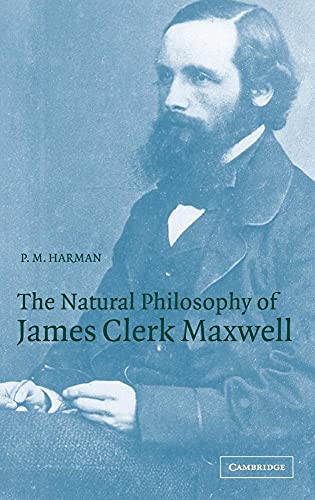
The Natural Philosophy of James Clerk Maxwell by P M Harman
This book provides an introductory yet comprehensive account of James Clerk Maxwell's (1831-79) physics and world view. The argument is structured by a focus on the fundamental themes that shaped Maxwell's science: analogy and geometry, models and mechanical explanation, statistical representation and the limitations of dynamical reasoning, and the relation between physical theory and its mathematical description. This approach, which considers his physics as a whole, bridges the disjunction between Maxwell's greatest contributions: the concept of the electromagnetic field and the kinetic theory of gases. Maxwell's work and ideas are viewed historically in terms of his indebtedness to scientific and cultural traditions, of Edinburgh experimental physics, and of Cambridge mathematics and philosophy of science, which nurtured his career. Peter M. Harman is Professor of the History of Science at Lancaster University. He has published primarily on the history of physics and natural philosophy in the 18th and 19th centuries, the period from Newton to Maxwell. His previous books include Energy, Force, and Matter (Cambridge, 1982), The Investigation of Difficult Things (Cambridge, 1992), After Newton: Essays on Natural Philosophy (Variorum, 1993), The Scientific Letters and Papers of James Clerk Maxwell, volume 1 (Cambridge, 1990), volume 2 (Cambridge, 1995).
'By stressing the deep traditionalism of Maxwell's enterprise, Harman makes him a participant in a philosophical conversation about matter, motion and mind, well-established by the time of Newton and continuing into this century' Simon Schaffer, London Review of Books
'The sections on Maxwell's physics in this book are presented with admirable clarity, particularly the intricacies of how his theory of electromagnetism developed, which are usually difficult to follow. This presentation gives the general reader a clear overview of Maxwell's work, while the discussion of how Maxwell's physics developed with time provides a good insight into how philosophical ideas matured.' Elizabeth Garber, Physics World
'… not the least of his talents is his ability to present brief, informed, and intelligible, accounts of the results of such analysis and use them in his argumentation.' Ole Knudsen, Centaurus
'The book is wonderfully informative and insightful throughout; its merit lies as much in stimulating questions as in providing answers.' Daniel Siegal, American Scientist
''Natural Philosopher' probably captures as much of Maxwell as any single label can, and Harman is to be commended for bringing a measure of synthesis to our picture of one of the most important but elusive figures of Victorian science.' Bruce J. Hunt, Book Reviews - Isis, 91
'James Clerk Maxwell (1831–1879) belonged to the 'golden age' of classical physics and contributed to many of its great achievements … In addition to the philosophical focus of the text, the book is full of interesting historical detail, and is very fully annotated; it would be enjoyed by anyone with a scholarly interest in the history of physics in the 'golden age'. C. W. P. Palmer, Contemporary Physics
'The sections on Maxwell's physics in this book are presented with admirable clarity, particularly the intricacies of how his theory of electromagnetism developed, which are usually difficult to follow. This presentation gives the general reader a clear overview of Maxwell's work, while the discussion of how Maxwell's physics developed with time provides a good insight into how philosophical ideas matured.' Elizabeth Garber, Physics World
'… not the least of his talents is his ability to present brief, informed, and intelligible, accounts of the results of such analysis and use them in his argumentation.' Ole Knudsen, Centaurus
'The book is wonderfully informative and insightful throughout; its merit lies as much in stimulating questions as in providing answers.' Daniel Siegal, American Scientist
''Natural Philosopher' probably captures as much of Maxwell as any single label can, and Harman is to be commended for bringing a measure of synthesis to our picture of one of the most important but elusive figures of Victorian science.' Bruce J. Hunt, Book Reviews - Isis, 91
'James Clerk Maxwell (1831–1879) belonged to the 'golden age' of classical physics and contributed to many of its great achievements … In addition to the philosophical focus of the text, the book is full of interesting historical detail, and is very fully annotated; it would be enjoyed by anyone with a scholarly interest in the history of physics in the 'golden age'. C. W. P. Palmer, Contemporary Physics
Harman, P. M.: - P. M. HARMAN is Professor of the History of Science at Lancaster University.
| SKU | Unavailable |
| ISBN 13 | 9780521561020 |
| ISBN 10 | 0521561027 |
| Title | The Natural Philosophy of James Clerk Maxwell |
| Author | P M Harman |
| Condition | Unavailable |
| Binding Type | Hardback |
| Publisher | Cambridge University Press |
| Year published | 1998-04-16 |
| Number of pages | 248 |
| Cover note | Book picture is for illustrative purposes only, actual binding, cover or edition may vary. |
| Note | Unavailable |