
The Nature of Order, Book Three: a Vision of a Living World


The Nature of Order, Book Three: a Vision of a Living World
Regular price
Checking stock...
Regular price
Checking stock...
Summary
Includes hundreds of photographic examples of buildings, public places, streets, rooms and gardens, most built by Alexander and his colleagues, in a great variety of cultures, showing how buildings and details governed by living process will be connected to human feeling, and what shape they must have.
The feel-good place to buy books
- Free US shipping over $15
- Buying preloved emits 41% less CO2 than new
- Millions of affordable books
- Give your books a new home - sell them back to us!
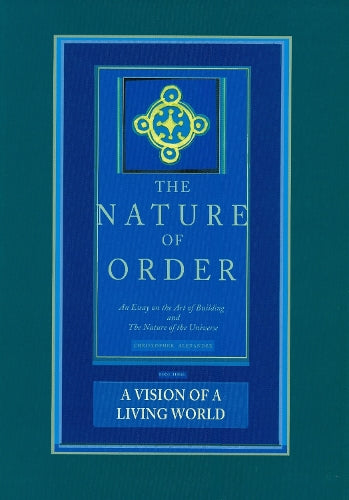
The Nature of Order, Book Three: a Vision of a Living World by Christopher Alexander
Christopher Alexander's series of ground-breaking books including A Pattern Language and The Timeless Way of Building have pointed to fundamental truths of the way we build, revealing what gives life and beauty and true functionality to our buildings and towns. Now, in The Nature of Order, Alexander explores the properties of life itself, highlighting a set of well-defined structures present in all order and in all life from micro-organisms and mountain ranges to good houses and vibrant communities. From a practical point of view, A Vision of a Living World is the most compelling of the four books. Hundreds of photographs and plans of new buildings that have living structure, and the processes which gave them life, demonstrate, for the first time, what the concept of living structure can mean in buildings of our time and of the future. The really good building. The really good space. Places that reach an archetypal level of human experience, reaching across centuries, across continents, across cultures, across technology, across building materials and climates. They connect us to ourselves. They connect us to our feelings. What is more, as we study them, we realize that they all share a similar geometry. How are they made? The practical task of making beauty is the principal subject of this volume. Hundreds of examples of buildings and places are shown. New forms for large buildings, public spaces, communities, neighborhoods, lead to discussions about equally important small scale of detail and ornament and colour. Many of the examples are built by Alexander and his colleagues; other buildings explored take us around the world and through time. With these examples, lay people, architects, builders, artists, and students are able to make this new framework real for themselves, understand how it works, and understand its significance. The book is a feast for the eyes, and mind, and heart. Places created by living process (Book 2) have living structure (Book 1), and they connect us to our essence as people (Book 4). The seven hundred pictures of Alexander's buildings and works of art shown in this book demonstrate in detail what he means. Taken as a whole, the four books create a sweeping new conception of the nature of things which is both objective and structural (hence part of science) and also personal (in that it shows how and why things have the power to touch the human heart). A step has been taken, through which these two domains the domain of geometrical structure and the feeling it creates kept separate during four centuries of scientific though from 1600 to 2000, have finally been united. The Nature of Order constitutes the backbone of Building Beauty: Ecologic Design Construction Process, an initiative aimed at radically reforming architecture education, with the emphasis of making as a way to access a transformative vision of the world. The 15 fundamental properties of life guide our work and have given us much more than a set of solutions. The Nature of Order has given us the framework in which we can search and build up our own solutions. In order to be authentically sustainable, buildings and places have to be cared for and loved over generations. Beautiful buildings and places are more likely to be loved, and they become more beautiful, and loved, through the attention given to them over time. Beauty is therefore, not a luxury, or an option, it includes and transcends technological innovation, and is a necessary requirement for a truly sustainable culture.
'This monumental work is the long awaited outcome of Christopher Alexander's reflections since the 1970sNo recent writer, I think, has viewed architecture so broadly, setting it in the context of all human making and living, and even of biology, cosmology and particle physics.' - Richard Padovan, The Architectural Review
'Alexander has a wonderful eye for the work of vernacular builders and anonymous artists.' - Richard Padovan, The Architectural Review
Christopher Alexander is a builder, craftsman, general contractor, architect, painter, and teacher. He taught from 1963 to 2002 as Professor of Architecture at the University of California, Berkeley, and is now Professor Emeritus. He has spent his life running construction projects, experimenting with new building methods and materials, and crafting carefully articulated buildings- all to advance the idea that people can build environments in which they will thrive. Acting on his deeply held conviction that, as a society, we must recover the means by which we can build and maintain healthy living environments, he has lived and worked in many cultures, and built buildings all over the world. Making neighborhoods, building-complexes, buildings, balustrades, columns, ceilings, windows, tiles, ornaments, models and mockups, paintings, furniture, castings and carvings- all this has been his passion, and is the cornerstone from which his paradigm- changing principles have been derived. Professor Alexander is a fellow of the American Academy of Arts and Sciences. He received his doctorate in Architecture from Harvard University after completing degrees at Cambridge University in mathematics and architecture. He is the winner of the first medal for research awarded by the American Institute of Architects, a member of the Swedish Royal Academy, recipient of the Distinguished Professor Award from the American Association of Collegiate Schools of Architecture, and the recipient of the Vincent Scully Prize awarded by the National Building Museum in the US, among many other prestigious awards throughout his career. Christopher Alexander writes ""I believe we are on the threshold of a new era when the proper understanding of the deep questions of space, as they are embodied in architecture will play a revolutionary role in the way we see the world and will do for the world view of the 21st and 22nd centuries, what physics did for the 19th and 20th.
| SKU | Unavailable |
| ISBN 13 | 9780972652933 |
| ISBN 10 | 0972652930 |
| Title | The Nature of Order, Book Three: a Vision of a Living World |
| Author | Christopher Alexander |
| Condition | Unavailable |
| Binding Type | Hardback |
| Publisher | Center for Environmental Structure |
| Year published | 2005-06-30 |
| Number of pages | 690 |
| Cover note | Book picture is for illustrative purposes only, actual binding, cover or edition may vary. |
| Note | Unavailable |